
The opportunity
The world runs on physical assets, and there are a great many of them. Every facility contains motors, pumps, fans, compressors, drives and electrical equipment. Every network that delivers power, water or goods is built from machines. A large share of that equipment is not monitored for condition in any continuous way. It is maintained on a schedule, inspected periodically or run until it fails.
The reason is economic, not technical. Thorough condition monitoring has required costly instruments and scarce specialists, so it has been reserved for the most critical machines. The opportunity AFFERENT is pursuing is to change that equation: to make continuous, intelligent observation inexpensive enough and dependable enough to apply broadly.
Why now
Several developments have matured within the same period.
- Sensors. Sensing components have fallen in cost and size while improving in quality.
- Edge computing. Processors that run machine-learning models efficiently now fit in small, low-power devices.
- AI inference. Methods for recognizing patterns in physical signals have advanced, and so have the tools for running them on constrained hardware.
- Infrastructure complexity. Facilities are denser, more automated and more tightly coupled, which raises the cost of any single failure.
- Data-center growth. Demand for computing is driving rapid construction of facilities whose cooling and power systems run close to their limits.
- Aging infrastructure. A great deal of equipment in service is old, and replacing it all is not practical.
- Industrial digitization. Operators have invested in connectivity and software and are prepared to use data in maintenance decisions.
- The cost of downtime. As operations become more continuous, unplanned interruption becomes more expensive.
Business model
AFFERENT's model has two components that reinforce each other.
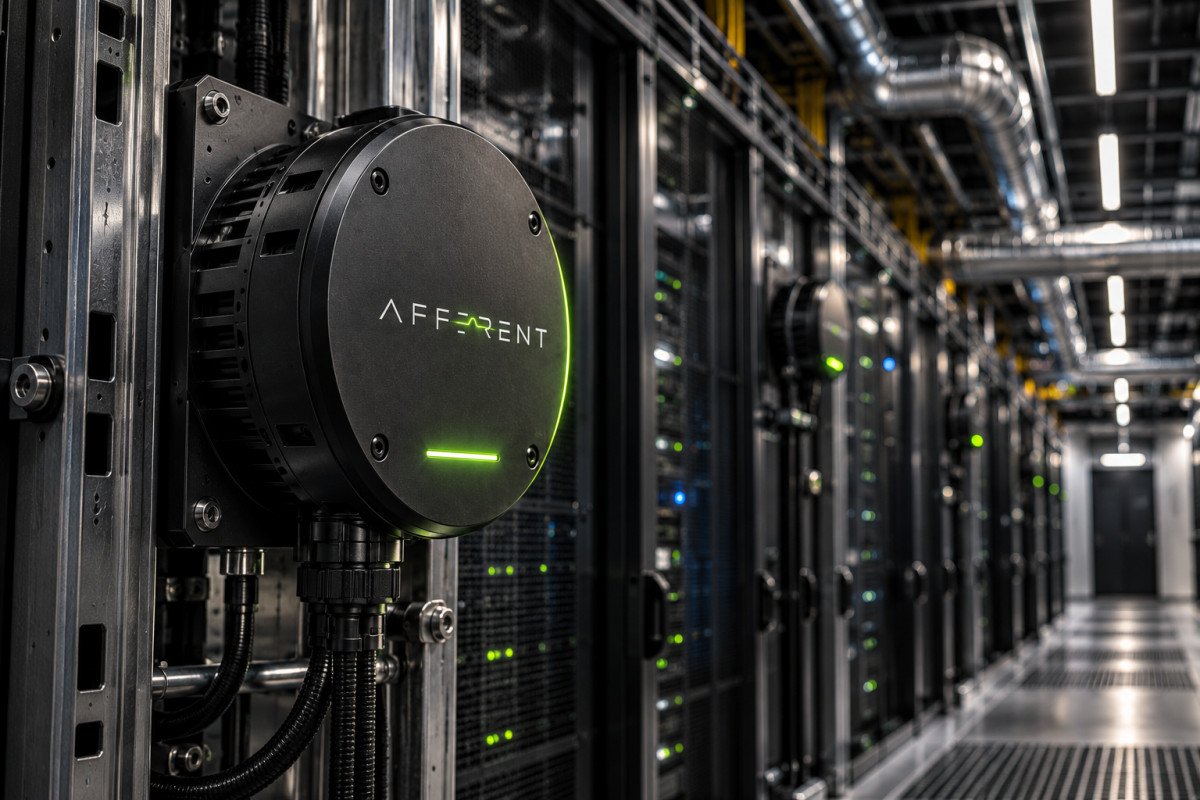
Hardware. NODE devices are installed on customer assets. Each device establishes a physical presence on a machine and begins producing data about it.
Recurring intelligence software. The continuing value is delivered through software: the analysis, the fleet-level view, the history and the improving models provided through AFFERENT Cloud.
Hardware creates the footprint. Software provides the continuing relationship. Pricing has not been published and is not described on this page.
Platform expansion
The same core technology applies across sectors. AFFERENT's intended sequence begins where the cost of failure is highest and the buyer is clearest, then widens.
Data centers, then manufacturing, then energy, then broader infrastructure, and in time the wider population of physical systems. Each step is intended to reuse the device platform, the edge architecture and the accumulated understanding of machine behavior developed in the step before.
Defensibility
We expect durable advantage in this market to come from sources that take time to build and are difficult to copy quickly.
- Deployment footprint. A device installed on an asset tends to stay there.
- Physical-world datasets. Data on how real equipment degrades can be gathered only by being present on that equipment over time.
- Edge architecture. Hardware and models designed together are harder to replicate than either alone.
- Machine behavior models. Models are intended to improve as they encounter more assets and more failure modes.
- Integrations. Connections to maintenance and operations systems make findings part of daily work.
- Workflow embedding. Once a team plans maintenance around a system's findings, the system is part of how the team operates.
- Network learning effects. What is learned on one asset is intended to benefit every similar asset.
These are the advantages we are working to build. They are described here as strategy, not as present achievement. See the investment thesis for the full argument.