
The facility behind the compute
A data center is usually described by what it computes. It is better understood as a machine for removing heat and delivering clean power. The servers are the reason the building exists. The building itself is pumps, chillers, cooling towers, air handlers, switchgear, transformers, uninterruptible power supplies and generators.
That supporting plant has always mattered. The growth of AI workloads has made it matter more. Processors used for training and inference draw far more power in a given space than the hardware that came before, and nearly all of that power leaves as heat. Cooling systems now work closer to their limits, with less time available to respond when one of them falters.
Where failure begins
Serious data center incidents rarely start in the servers. They start in the equipment that keeps the servers within their operating envelope.
- Cooling. A pump bearing wears. A fan drifts out of balance. A valve sticks. A compressor begins to struggle. Each of these develops over time and announces itself physically before it becomes a thermal event.
- Power. Connections loosen and warm. Transformers and switchgear age. Batteries and rotating backup systems degrade while standing by, unnoticed until they are called on.
- Standby equipment. Generators and redundant units spend most of their lives idle. Their condition at the moment of need is exactly what an operator most wants to know and has the least continuous evidence about.
The limits of existing monitoring
Data centers are among the most heavily instrumented buildings in existence. Building management and infrastructure management systems track temperatures, flows, pressures and electrical loads in great detail. What they measure, for the most part, is the process: whether the plant is delivering what the hall requires.
Process measurements move late. Supply temperature holds steady while a redundant pump compensates for a failing one. Flow looks normal until the bearing that is producing a new vibration finally gives way. Redundancy, which exists to protect the load, also hides the early evidence that a component is in trouble.
Condition monitoring looks at a different layer: the mechanical and electrical health of each individual asset, independent of whether the system as a whole is still coping. That is the layer AFFERENT is built to observe.
How AFFERENT is designed to help
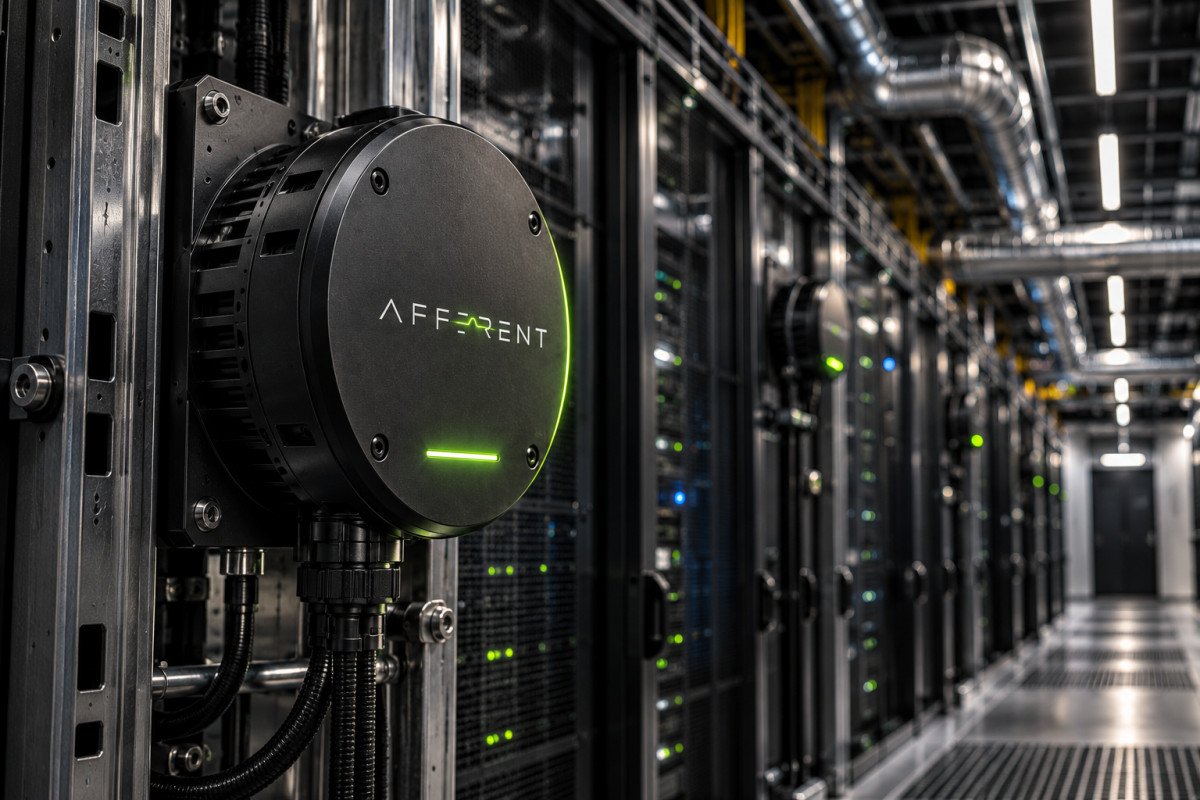
NODE is designed to mount directly on plant equipment and to observe it through several kinds of sensing at once. A device on a chilled-water pump is intended to learn that pump's normal vibration, sound and temperature across its range of operation, and to recognize when the pattern begins to shift.
Analysis runs at the edge, which suits the data center environment. Devices do not need to stream raw data across a tightly controlled network, and they are designed to keep observing during a network interruption.
AFFERENT Cloud is designed to bring those findings together across a facility or a portfolio of sites, so an operator can see which assets are healthy, which have changed and which should be looked at first.
What that could change
For an operator, the aim is a shift from scheduled and reactive maintenance toward maintenance informed by condition. A pump that is degrading can be serviced in a planned window instead of failing under peak load. A standby unit whose condition is known can be relied on. Maintenance effort can be directed to the equipment that needs it.
The same visibility has value when a facility is commissioned, when equipment is under warranty and when capacity is being planned against the real condition of the plant.
Liquid cooling raises the stakes
Air cooling is forgiving in one respect: a large volume of air in a hall takes time to heat up. Liquid cooling, which many high-density facilities are adopting, moves heat far more effectively and leaves less thermal reserve. A loop that stops circulating gives its operators very little time.
Liquid systems also add machinery close to the computing equipment. Coolant distribution units, secondary pumps, heat exchangers, valves and filtration all become part of the path between a processor and the outside air. Each is a mechanical component with its own ways of degrading: pump bearings and seals wear, strainers clog and change the load on a pump, and valves and actuators stick. A monitoring approach built around the condition of individual machines suits this kind of plant well, because the early evidence is mechanical and local.
Fitting into an operating facility
Operators are right to ask how any new system will behave in a live facility. Four points guide the design.
- No interruption to install. A device should be mountable on running equipment, without taking a pump or fan out of service.
- Separate from control. NODE is designed to observe and never to command. It sits outside the building management and control systems, so it cannot affect how the plant is run.
- Respect for network boundaries. Facilities segment their operational networks carefully. Edge analysis keeps data volumes small, and device-initiated communication avoids opening inbound paths. See security architecture.
- Findings where teams already work. Operators already watch infrastructure management and maintenance systems. The intended route for AFFERENT findings is into those tools through integrations, with a dedicated view available for deeper investigation.
Questions operators ask
Does this replace the building management system?
No. The management system controls the plant and reports on the process. AFFERENT is designed to add the layer it does not cover: the mechanical and electrical condition of each asset.
Which equipment should be covered first?
Usually the assets whose failure has the fastest effect on the hall, and the standby equipment whose condition is least visible: cooling pumps, fans in air handling and heat rejection, and backup power plant.
What accuracy can be expected?
AFFERENT does not publish accuracy figures at present. They will be stated once they have been validated on real equipment at a meaningful scale, with the conditions under which they were measured.


