
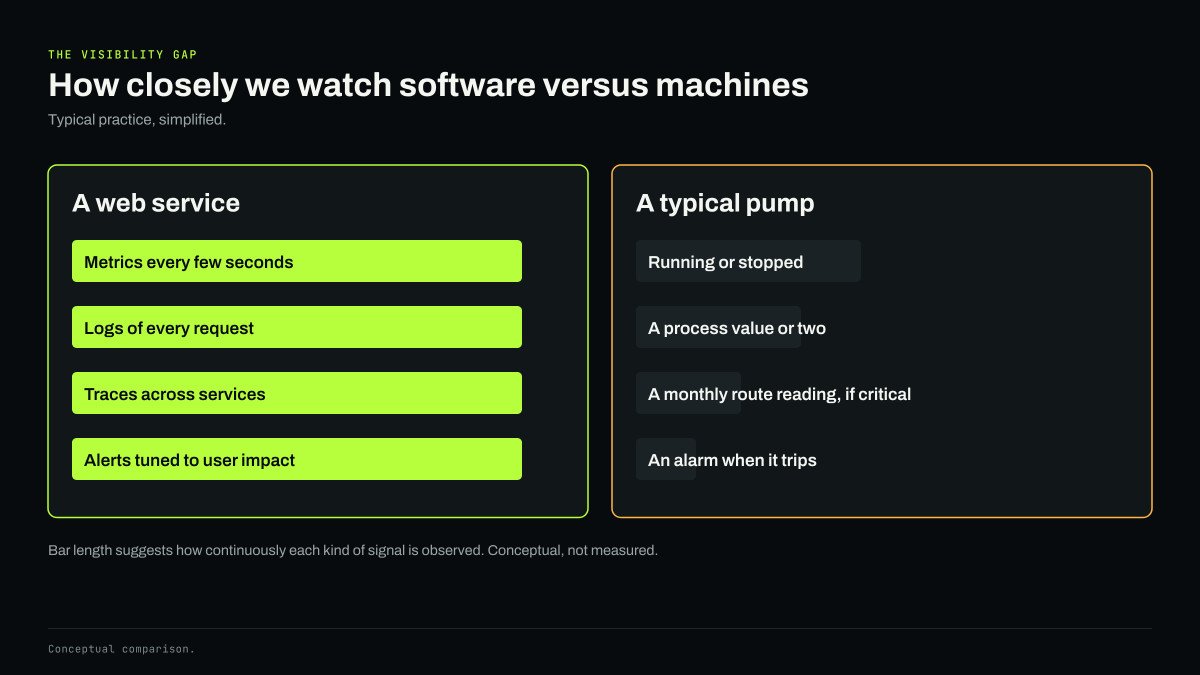
Consider how closely the modern world watches its software. A popular web service records every request it handles, measures its own response time every few seconds, traces each transaction across dozens of internal systems and wakes an engineer within minutes if users start to notice a slowdown. Entire industries exist to make software observable.
Now consider the pump that moves water to a hospital, the transformer that feeds a neighborhood, or the chiller that keeps a data center from overheating. In most places, those machines report whether they are running, perhaps a temperature or a pressure, and an alarm when something has already gone wrong. Someone might take a vibration reading once a month, if the machine is considered important enough. The rest of the time, nobody is really watching.
Put simply, the physical world is still under-instrumented. That is one of the stranger facts about modern infrastructure, and one of the most consequential.
The equipment underneath everything
The U.S. Cybersecurity and Infrastructure Security Agency identifies 16 critical infrastructure sectors whose incapacitation would have a debilitating effect on security, the economy, or public health and safety. They include energy, water, healthcare, manufacturing, transportation, and communications and information technology.
Look past the sector names and the same kinds of machines appear again and again. Pumps, motors, fans, compressors, transformers, switchgear, chillers and generators do the physical work in nearly all of them. They are ordinary, well understood and built to last for decades. Each one is unremarkable. Together they are what keeps the lights on, the water running and the servers cool.

Instrumented for control, not for condition
It would be wrong to say these machines have no sensors. Many have plenty. The issue is what those sensors are for.
Industrial instrumentation grew up around control. A controller needs to know the process variable it is regulating, such as a flow, a pressure or a temperature, and whether the equipment is on. That is what was measured, because that is what was needed to run the process. Measuring the health of the machine doing the work was a separate discipline, condition monitoring, applied only where the stakes justified the cost.
The result is a gap that is easy to miss from a control room. The screens are full of data, and nearly all of it describes the process, not the machines. A pump can deliver exactly the right flow while its bearing is failing. A transformer can carry its load while its insulation degrades. The control system sees nothing wrong until something stops.
Why the gap persisted
The gap was not an oversight. It was a rational response to costs that have only recently changed.
Condition monitoring used to mean expensive instruments, specialist analysts and wired installations. A permanently installed vibration system for a large turbine could be justified. The same system on a hundred ordinary pumps could not. So most equipment was maintained on schedules, inspected periodically by technicians with portable instruments, and otherwise run until it showed obvious symptoms.
Interpretation was the other bottleneck. Even where data was collected, reading it required expertise that was scarce and expensive. A vibration spectrum means little to a non-specialist. Many plants that invested in monitoring found the data piling up faster than anyone could look at it.
Finally, the people responsible for infrastructure are cautious, and with good reason. Their systems must be safe and reliable above all else. Adding new devices to critical equipment, and new connections to operational networks, is not something they do lightly.
Why it matters more now
Several pressures are making the gap harder to live with.
Infrastructure is aging. The American Society of Civil Engineers gave the United States an overall grade of C in its 2025 Infrastructure Report Card and estimated a $3.6 trillion investment gap over the next ten years. When replacement is slow, existing equipment has to run longer, and knowing its condition becomes more valuable.
Downtime costs are rising. As we described in our look at the economics of downtime, survey data shows the cost of an hour of unplanned downtime has risen sharply in several industries over the past five years.
Demands are concentrating. Data centers built for AI pack far more power and heat into each rack than older facilities. Electrification is adding load to grids. Hospitals and water systems serve growing populations with infrastructure built for smaller ones. More depends on each machine.
Experience is retiring. Much of the knowledge about how equipment sounds and behaves when something is wrong lives in the heads of experienced technicians. As they leave the workforce, that informal monitoring disappears with them.
The cost of not knowing
The gap has a price, even when nothing fails. Equipment maintained on fixed schedules gets attention it does not need while other machines decline unnoticed. Spare parts are stocked for every possibility because nobody knows which failure is coming. Redundant equipment is installed and then trusted blindly, although a standby pump that has not been checked may be in no better shape than the one it is meant to replace. And when something does fail, the investigation often finds that the warning signs were there for weeks, in a signal that nobody was recording.
What has changed on the other side
At the same time, the economics of sensing and interpretation have shifted. Sensors that measure vibration, sound and temperature are small and inexpensive. Processors capable of analyzing those signals fit inside a device that can be mounted on a machine. Low-power wireless and industrial networking make installation simpler. And machine learning can take on part of the interpretation that once required a specialist, applied consistently across thousands of assets.
Security practice has matured too. Guidance for operational technology now describes how to add devices and data flows to industrial networks without opening paths into control systems, which removes one of the most legitimate objections to monitoring. None of this removes the need for engineering judgment. But it changes the question from whether monitoring can be justified on a given machine to which machines can afford to go unwatched.
One building, walked through
The gap is easiest to see in a single facility. Take a mid-sized hospital, a building that runs around the clock and cannot tolerate surprises. Its building management system typically collects thousands of data points. Look closely at what they describe.
| Equipment | Usually measured | Usually not measured |
|---|---|---|
| Chillers | Water temperatures, setpoints, run status, alarms | Compressor bearing condition, motor insulation health |
| Air handlers | Supply air temperature, fan on or off, filter pressure | Fan bearing wear, belt condition, imbalance |
| Pumps | Run status, sometimes pressure | Vibration, seal condition, cavitation |
| Electrical rooms | Breaker status, some meter readings | Connection hot spots between annual surveys |
| Generators | Test results, fuel level | Condition between monthly tests |
The left column tells the building how to operate: whether equipment is running and whether it is meeting its targets. The right column tells the building whether that equipment will keep running. Almost all of the instrumentation sits on the left. The right is covered, if at all, by periodic rounds and annual surveys.
That is the under-instrumentation problem in miniature. The building is rich in data and still largely blind to the condition of the machines it depends on.
What closing the gap looks like
Closing the gap does not mean copying software observability onto machines. A pump does not need a log entry for every revolution. What it needs is closer to what a good technician provides: continuous attention to the signals that reveal its condition, an understanding of what normal looks like for that machine, and a clear report when something changes.
In practice that means devices on the equipment that sense several physical signals, analysis close to the machine so that findings rather than raw data travel over constrained networks, and software that turns those findings into decisions a maintenance team can act on. It also means respecting the constraints of critical environments: security by design, no interference with control systems, and a measured path from observation to any kind of automated action.
The idea behind this is the one we described in why machines need a nervous system. Infrastructure has a well-developed ability to act and a weak ability to sense its own condition. Fixing that imbalance is the work of critical infrastructure monitoring.
A long road, worth taking
The physical world will not become as observable as software overnight, and it should not try to. The equipment is too varied, the environments too harsh and the stakes too high for a rush. Progress will come asset by asset, starting where failures are most expensive and evidence is easiest to gather.
But the direction is clear. We have spent decades making sure we know, second by second, how our software is behaving. It is time to extend some of that attention to the machines everything else depends on.


