
People often talk about predictive and preventive maintenance as if one were simply the modern version of the other. They are different strategies built on different assumptions about how equipment fails, and each is the right answer for some assets and the wrong answer for others. This comparison sets out how they work, what the evidence says about their costs, and how to decide between them asset by asset.
Four ways to maintain a machine
Reactive maintenance runs equipment until it breaks and then repairs it. It needs no planning and no instruments, and it is the cheapest approach right up to the day it becomes the most expensive.
Preventive maintenance services or replaces components at fixed intervals of calendar time, run hours or cycles. Oil is changed every so many hours; bearings are replaced at a set age. It avoids many failures, at the cost of discarding parts that still had useful life.
Condition-based maintenance intervenes when a measured indicator crosses a limit: vibration above a severity zone, oil contamination above a threshold, a temperature rise above a set value.
Predictive maintenance goes a step further. It monitors condition continuously or frequently, tracks how indicators are trending, and estimates when intervention will be needed, so work can be planned for a convenient window before failure.
The comparison at a glance
| Dimension | Preventive | Predictive |
|---|---|---|
| Trigger for work | Time, run hours or cycles | Measured condition and its trend |
| Assumes failure is | Age related and predictable from use | Preceded by detectable warning signs |
| Upfront investment | Low: schedules, procedures, parts | Higher: sensors, software, training |
| Typical waste | Parts replaced with life remaining; intrusive work that can introduce faults | False alarms and missed detections if poorly tuned |
| Handles random failures | Poorly | Well, if the failure gives warning |
| Skills needed | Planning and craft skills | Planning, craft and diagnostic skills |
| Best suited to | Wear-out items, low-cost assets, regulated tasks | Critical assets with long warning periods |
The assumption that breaks preventive maintenance
Calendar-based work makes sense when the probability of failure rises predictably with age. Tires, brake pads and many components in direct contact with a product wear out in a way a schedule can follow. The difficulty is that a large share of components do not behave like that.
The classic evidence comes from aviation. In their 1978 report on reliability-centered maintenance for the U.S. Department of Defense, Stanley Nowlan and Howard Heap of United Airlines analyzed the failure patterns of aircraft components. Some 89 percent of the items analyzed had no wear-out zone, so their performance could not be improved by imposing an age limit. Many failed at a roughly constant rate regardless of age, and some were most likely to fail just after installation or overhaul.
For those items, replacing on a schedule spends money without reducing risk, and the intrusive work can introduce new early-life failures. The only way to reduce failures of that kind is to detect them as they develop, which is the premise of predictive maintenance.
What the costs look like
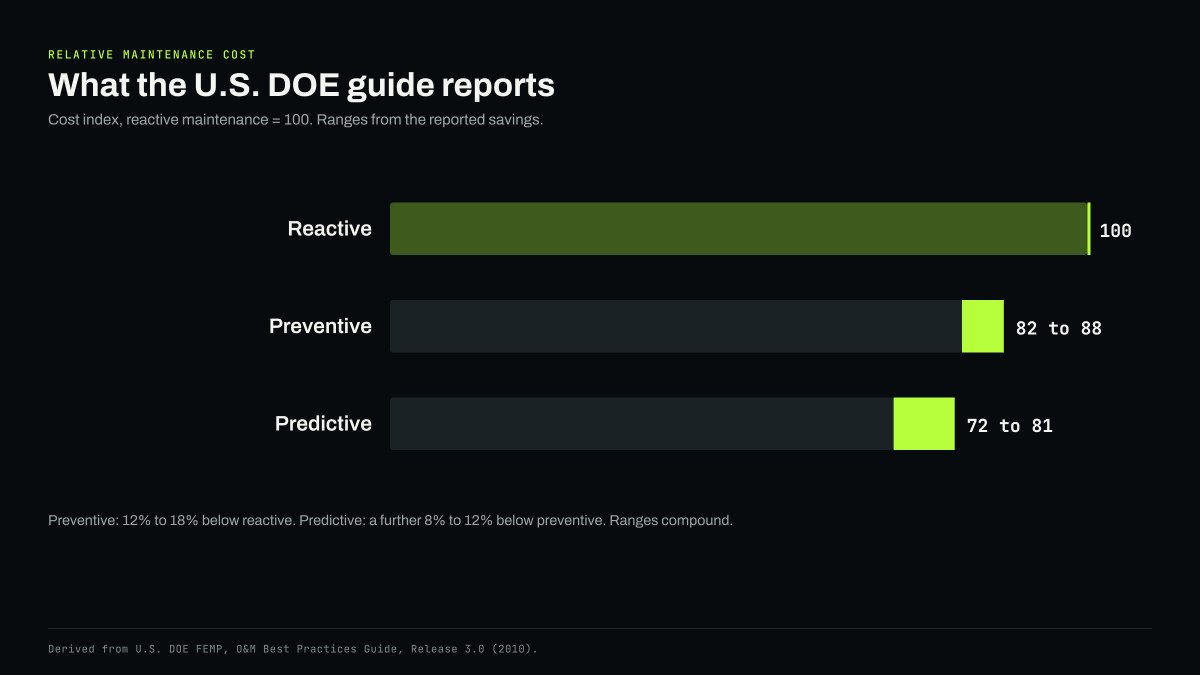
Published cost comparisons should be read with care, because results depend heavily on the starting point and the asset mix. The most widely cited figures in the United States come from the Department of Energy's Federal Energy Management Program. Its Operations and Maintenance Best Practices Guide reports that a preventive program can save 12 to 18 percent compared with purely reactive maintenance, and that a properly functioning predictive program can save a further 8 to 12 percent compared with preventive maintenance alone.
The same guide cites independent surveys of industrial predictive programs reporting maintenance cost reductions of 25 to 30 percent, 70 to 75 percent fewer breakdowns and 35 to 45 percent less downtime. Those are averages across programs that were set up well, and the guide is explicit that savings depend on implementation. A predictive program with poor data, untuned alarms or no follow-through will deliver much less.
Predictive maintenance has never been just a question of whether we can detect a problem. It's also a question of time, resources and expertise. We want technology to help close that gap, so the people responsible for machines can make better decisions before something fails.
Where predictive maintenance struggles
The weaknesses are practical rather than theoretical. Instruments and analysis cost money, so coverage has traditionally been limited to the most critical machines. Interpretation needs skills that many sites lack. Fixed thresholds applied across different machines produce false alarms, and alarm fatigue can slowly kill a program. And the benefit is invisible when it works: a failure that did not happen does not appear on anyone's report.
The economics of the first two problems are changing. Sensors and embedded processors are cheap enough to put on ordinary assets, and models can carry part of the interpretation load. The third problem is a design issue: systems that learn each machine's own baseline and corroborate across several signals produce fewer, more specific alerts. The fourth is a management issue that good record keeping can address.
Choosing, asset by asset
The right strategy is a property of each asset and failure mode, not of a whole plant. Reliability-centered maintenance offers a straightforward line of questions.
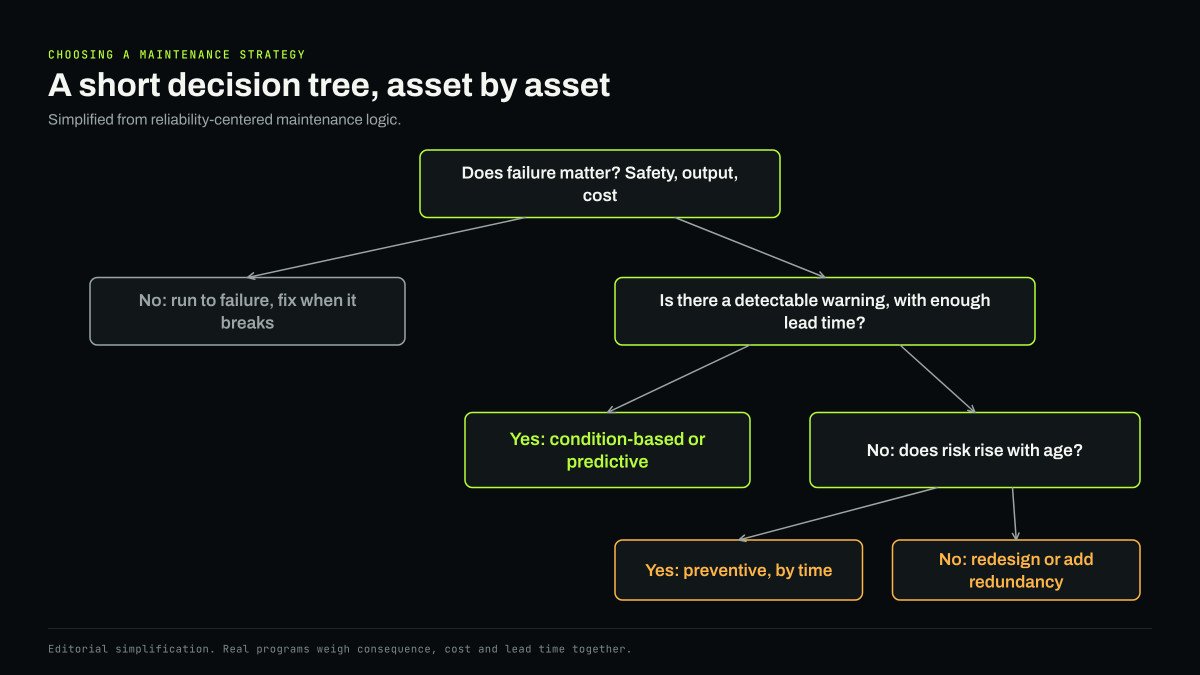
If a failure has little consequence and is cheap to fix, running to failure is a legitimate choice. Where the consequence matters and the failure gives a detectable warning with enough lead time to act, condition-based or predictive maintenance is the strongest option. With no useful warning but a risk that rises with age, time-based replacement makes sense. And when there is neither a warning nor an age pattern, the answer is design: add redundancy, change the component or change how it is operated.
Two assets, two answers
Applying the questions to real equipment shows why plants end up with a mix. Take a cooling tower fan gearbox at a data center or a process plant. A failure takes a cell out of service during peak load, replacement parts can take weeks to arrive, and the gearbox gives good warning through vibration and oil condition long before it fails. Every answer points to predictive maintenance: monitor it continuously, trend it, and plan the repair for a cool season.
Now take a small exhaust fan in a storage room. If it fails, nobody is harmed and nothing stops; a spare sits on the shelf and a technician can swap it in an hour. Monitoring it would cost more than the failures it prevents. Running it to failure is the rational choice, and spending effort on it would take attention away from assets that matter more.
Between those extremes sit thousands of ordinary pumps, motors and air handlers. They have historically defaulted to calendar maintenance because monitoring them was too expensive. As the cost of sensing and interpretation falls, more of them cross the line where condition-based or predictive maintenance pays for itself.
Knowing whether it is working
A maintenance strategy should be judged by results, and a few measures tell most of the story. The share of maintenance work that is planned rather than reactive shows whether problems are being caught early. Mean time between failures for critical assets shows whether reliability is improving. The proportion of condition alerts that lead to a confirmed finding shows whether the monitoring is trusted or ignored. Tracked before and after a change, those numbers turn a debate about strategy into an argument about evidence.
How the warning window sets the inspection interval
A useful rule from reliability practice links condition monitoring to time. The window between the point where a developing fault first becomes detectable and the point of functional failure is often called the P to F interval. For condition-based work to catch a fault, inspections have to happen well inside that window, and a common rule of thumb is to inspect at no more than half the interval, so that at least one, and preferably two, observations fall between detection and failure.
A worked example shows how much the measurement method matters. Suppose a rolling bearing defect becomes visible to vibration analysis about twelve weeks before failure, to ultrasound around eight weeks before, to temperature only two weeks before, and to a human ear or hand a few days before. A monthly vibration route, at four week intervals, gives two or three chances to catch it. A monthly temperature check could miss it entirely. A weekly walk-round relying on noise and touch catches it only at the last moment, if at all.
| Method | Illustrative warning window | Interval needed |
|---|---|---|
| Vibration analysis | About 12 weeks | 6 weeks or less |
| Ultrasound | About 8 weeks | 4 weeks or less |
| Temperature | About 2 weeks | 1 week or less |
| Noise and touch | A few days | Daily |
The windows vary widely between machines and faults, so the numbers are for illustration. The logic does not vary: the earlier the method sees a fault, the less often you need to look, and continuous monitoring removes the interval question altogether.
A practical blend
Most effective programs end up mixed. Lubrication, filter changes and regulated inspections stay on schedules. Critical rotating equipment, electrical distribution and cooling systems move to condition-based and predictive approaches. Low-value assets with spares on the shelf run to failure. The shift that matters is from a default of calendar maintenance to a default of evidence, with schedules kept where the evidence supports them.
That shift is what makes predictive maintenance applications worthwhile in a plant, and it depends on interpretation that is cheap enough to apply widely, which is the problem Machine Health Intelligence is meant to address.


