

"AI factory" has become the industry's favorite phrase for a data center built to train and run AI models. The metaphor is meant to say something about output: data goes in, intelligence comes out, at industrial scale. It is a good metaphor, though perhaps not for the reason its users intend. The most useful thing about calling a data center a factory is that it reminds us factories are physical places, full of machines that wear, overheat and fail, and that the industries running them learned long ago how much discipline that takes.
A factory runs on its plant
Walk through any manufacturing site and the production line is only part of what you see. Behind it are compressors, pumps, chillers, transformers, switchgear and conveyors. Plant engineers call this the utilities or the balance of plant. It is rarely glamorous, and when it stops, production stops with it.
An AI data center has the same structure. The GPUs are the production line, and they are what visitors are shown on a tour. Behind them sit utility feeds, transformers, switchgear, uninterruptible power supplies, generators, chillers, cooling towers, pumps, coolant distribution units and miles of piping. Every token a model produces depends on that physical chain working, and most of the chain is equipment that would look familiar in a chemical plant or a hospital basement.

The scale has changed the physics
What makes the comparison more than a figure of speech is the scale. The International Energy Agency's Energy and AI report, published in April 2025, projects that electricity demand from data centers worldwide will more than double by 2030 to around 945 terawatt-hours, slightly more than Japan's entire electricity consumption today. A December 2024 report for the U.S. Department of Energy found that data centers consumed about 4.4 percent of U.S. electricity in 2023 and could reach 6.7 to 12 percent by 2028.
The change inside the building is just as large. Uptime Institute's 2024 global survey put the average typical rack density at about 8 kilowatts. NVIDIA's documentation for its GB200 NVL72 system, a single liquid-cooled rack holding 72 GPUs, gives its power consumption as approximately 120 kilowatts. Heat at that density cannot be carried away by air alone, so coolant is pumped through cold plates on the chips. A facility like that has more in common with a process plant than with the server rooms of a decade ago.
Liquid cooling turns the building into a process plant
The move to liquid cooling deserves particular attention, because it changes the kind of equipment a data center depends on. Air cooling relies on fans, air handlers and chillers. Direct liquid cooling adds coolant distribution units, pumps that run around the clock, heat exchangers, filters, quick-disconnect couplings and leak detection, all serving cold plates bolted directly to the most expensive chips in the building.
Process engineers will recognize the list. Pumps develop bearing and seal wear. Filters clog and change the pressure drop across a loop. Heat exchangers foul and lose effectiveness slowly, so the system compensates by running harder until it has no margin left. Coolant chemistry drifts. These failures are rarely sudden, and nearly all of them give physical warning through vibration, temperature, pressure or flow. The question is whether anyone is reading it.
Single points of physical failure
In a process plant, engineers map how a failure in one component propagates. The same exercise in an AI data center is instructive. A failing pump bearing reduces coolant flow. Reduced flow raises chip temperatures. The hardware throttles to protect itself, so a training job slows across thousands of GPUs, or the system shuts down a rack. A loose connection in a busway heats up over weeks until it trips a breaker. A cooling tower fan with a developing imbalance runs for months before it fails on the hottest afternoon of the year.
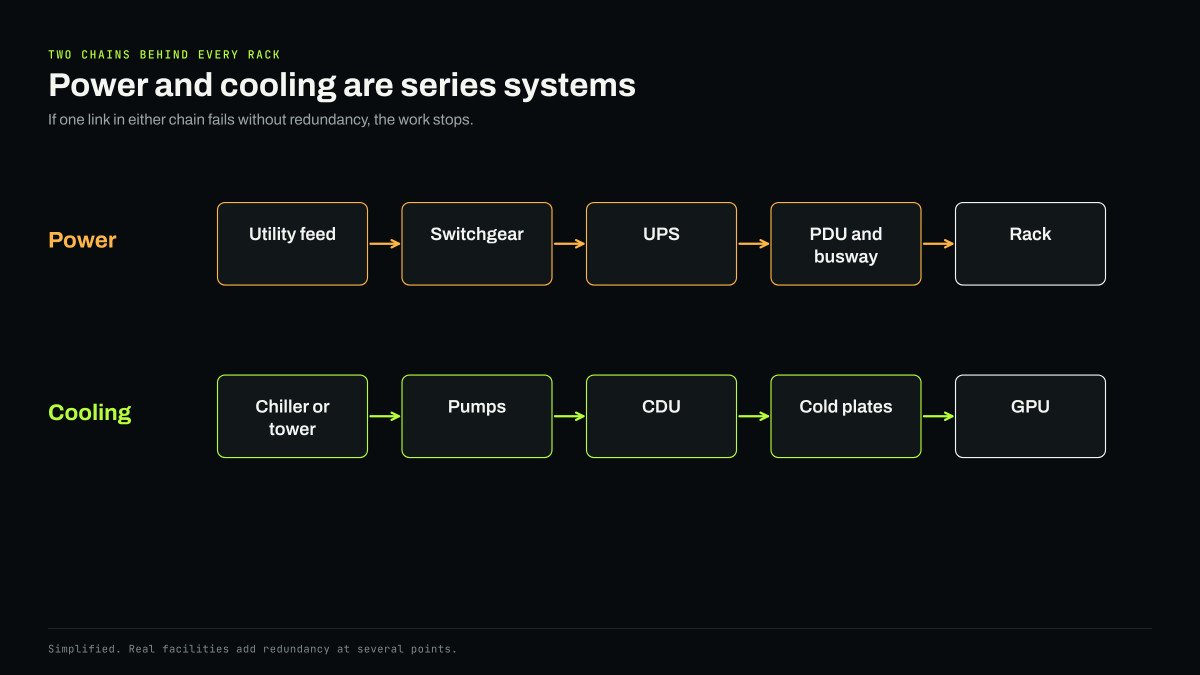
These faults are not exotic. They are the faults maintenance teams in manufacturing, utilities and process industries deal with every day. What is new is how much compute, and how much money, sits at the end of each chain.
What factories already know
Manufacturing has spent decades building the practices that keep physical plants running. Three of them translate directly.
Know the condition of every critical asset. Good plants do not wait for a pump to fail; they trend its vibration, temperature and current, and plan work before the failure. In many data centers, the equivalent visibility stops at the building management system, which reports set points and alarms but says little about the health of the machines themselves.
Treat maintenance as part of production. In a factory, downtime for the plant is downtime for the line, so maintenance planning sits close to production planning. In an AI factory, a pump replacement scheduled into a planned maintenance window costs little; the same replacement forced by a failure during a large training run costs a great deal.
Design for the failure you expect. Redundancy, spares strategy and condition monitoring are chosen together, based on which failures are likely and what they cost. Redundancy protects against a sudden failure, but it can also hide a slow one until the backup is needed and turns out to be degraded as well.
Maintenance windows are scarce
AI workloads add a scheduling problem that most factories would recognize. Large training runs can occupy thousands of accelerators for weeks, and stopping them is costly. That makes planned maintenance windows precious. A team that knows which pump is degrading can use the next window for that pump; a team that does not either replaces parts on a calendar, using windows on equipment that did not need attention, or waits for the failure that chooses its own time.
People are the other constraint. Uptime Institute's 2025 outage analysis found that nearly 40 percent of organizations had suffered a major outage caused by human error in the previous three years, and Uptime has linked staffing pressure in a fast-growing industry to that problem. Better condition information does not replace skilled technicians, but it helps a small team spend its time on the machines that need it.
A factory reliability program, applied to a data hall
If the AI factory is still a factory, the tools of factory reliability apply directly. A mature manufacturing plant typically runs a program with five parts, and each translates cleanly to the mechanical and electrical plant behind AI computing.
- Criticality ranking. Every asset is scored by the consequence of its failure. In a data hall, a coolant distribution unit serving a dense GPU row ranks far above a comfort cooling unit in an office.
- Failure mode analysis. For the most critical assets, engineers list how each can fail, how each failure would show itself, and what would detect it early. This is where the choice between periodic inspection and continuous monitoring is made, asset by asset.
- Spare parts strategy. Long lead time components, such as large transformers, specialized pumps and switchgear parts, are identified and either stocked or covered by agreements before they are needed.
- Condition monitoring. Rotating equipment and electrical connections are watched in proportion to their criticality, with findings feeding planned work.
- Measurement. The program tracks planned versus unplanned work, maintenance backlog and repeat failures, and treats every unplanned event as something to learn from.
None of this is new. It is simply the discipline that keeps production plants running, applied to a building whose product happens to be computation.
Where the metaphor should lead
If the industry takes its own metaphor seriously, it ends up somewhere useful. The physical layer of an AI factory deserves the same kind of continuous, machine-level condition monitoring that the best factories apply to their critical assets: sensors on pumps, fans, transformers and switchgear; analysis that learns each machine's normal behavior; and alerts specific enough for a technician to act on.
In practice, that means a short list of assets and the signals that suit them. Pumps and cooling tower fans are watched through vibration and bearing temperature. Coolant loops are watched through flow, pressure and temperature differences across heat exchangers and filters. Transformers are watched for heat and changes in acoustic character. Busway joints and switchgear connections are watched for temperature, because a loose joint announces itself as heat long before it fails. These measurements are familiar to any reliability engineer. What is new is the ability to collect them continuously from every asset that matters and interpret them automatically, instead of relying on quarterly thermography and monthly walk-downs.
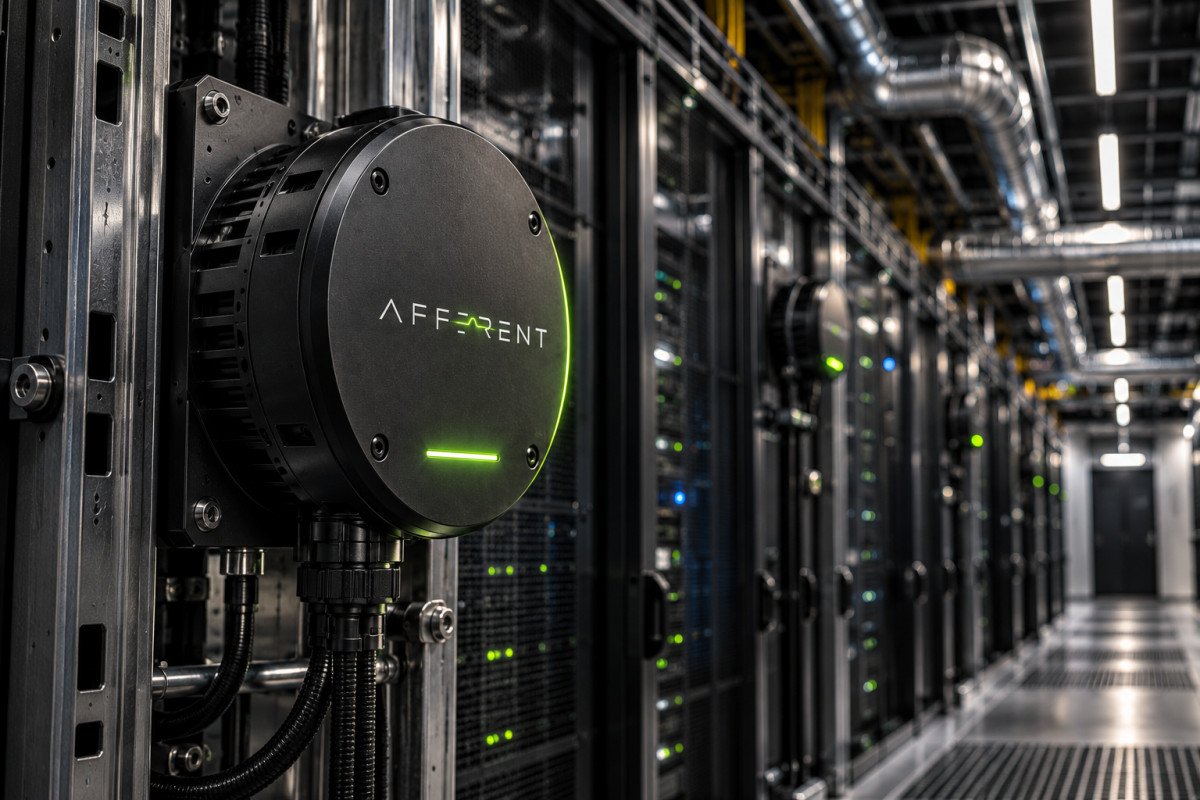
We have written about the operational record in more detail in AI data centers have a physical reliability problem. The broader point is simple. An AI factory is still a factory. Its output is digital, but its uptime is decided by the physical systems behind AI infrastructure.


