

Two companies can ship devices that look similar on a spec sheet. Both mount on a motor, measure vibration and temperature, and send data to a web dashboard. One is a sensor company. The other is trying to become an intelligence platform. The difference does not show up in the hardware. It shows up in what the customer receives, how value grows over time, and what happens when the customer tries to leave.
That distinction matters to buyers choosing a system, to investors judging a business, and to the companies themselves, because the two models call for different products, different teams and different economics.
Two different businesses
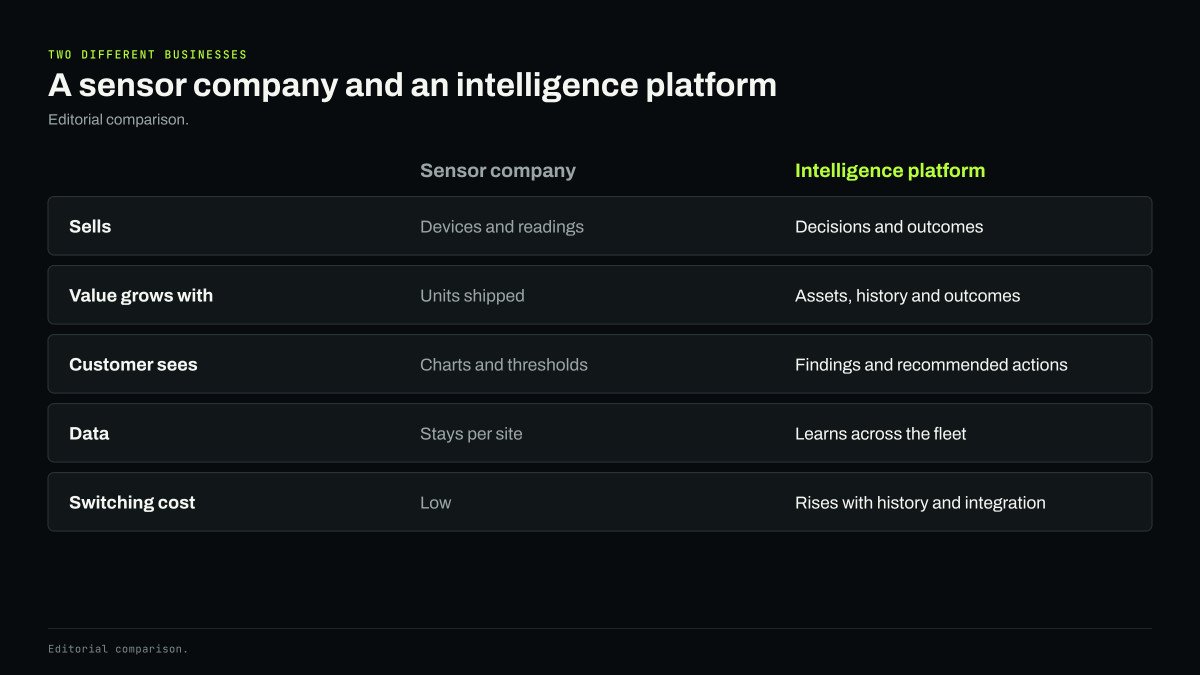
A sensor company sells measurements. Its product is a device and the readings it produces. The customer receives charts, thresholds and alarms, and the customer's own engineers do the interpretation. Value grows with units shipped. Each site is largely independent, and switching to a competitor means replacing devices and rebuilding some dashboards.
An intelligence platform sells decisions. Its product is a finding: what is changing in a machine, how serious it is and what to do about it. Value grows with the number of assets, the depth of their history and the record of confirmed outcomes. Learning from one site can improve results at others. Switching means losing history, integrations and a track record of trusted findings.
Both are legitimate businesses. Many sensor companies are profitable and serve customers who have the expertise to interpret raw data. But the two are not the same, and trying to be both without choosing tends to produce a product that is neither a cheap, simple sensor nor a trusted source of decisions.
The layers of a platform
The idea that machine condition monitoring has distinct layers is not new. ISO 13374-1, first published in 2003, sets general guidelines for software that processes, communicates and presents machine condition monitoring and diagnostic information. Its processing model moves from data acquisition and manipulation through state detection, health assessment and prognostics to advisory generation. So the standard already recognized that a measurement is only the first step on the way to a useful recommendation.
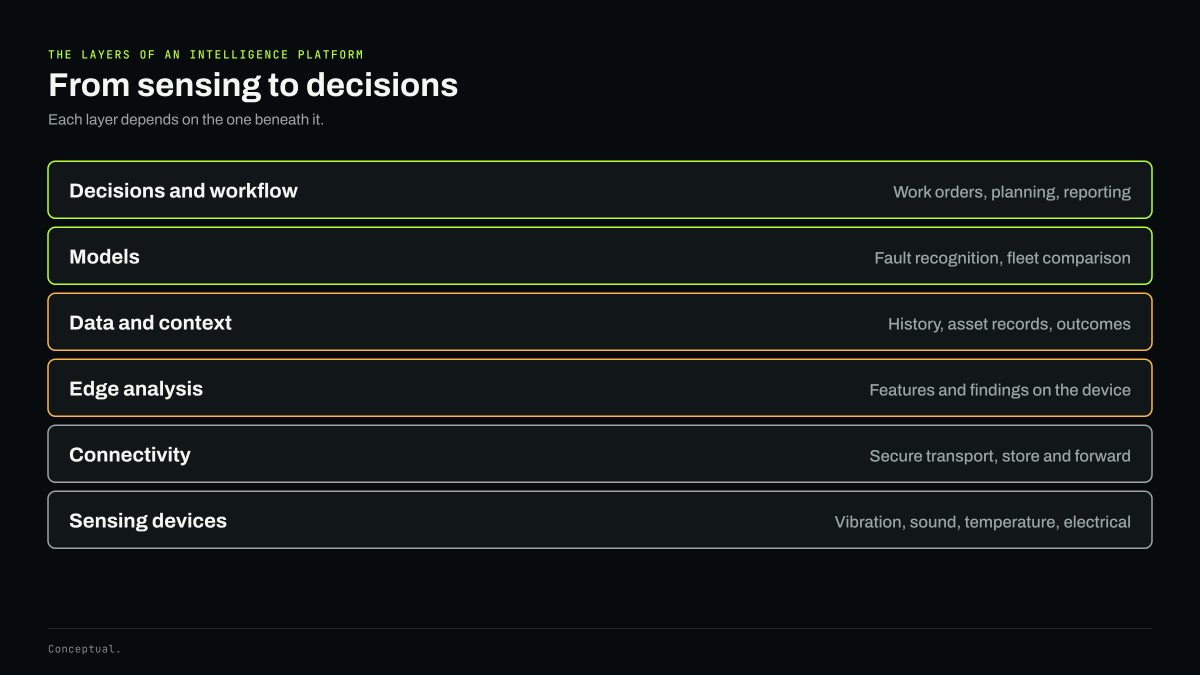
A modern platform maps onto six layers.
- Sensing devices capture vibration, sound, temperature and electrical signals at the machine.
- Connectivity moves data securely, with store and forward for outages.
- Edge analysis turns raw signals into features and findings on the device.
- Data and context hold history, asset records and confirmed outcomes.
- Models recognize faults, compare assets across a fleet and estimate severity.
- Decisions and workflow turn findings into work orders, plans and reports inside the customer's own systems.
Sensor companies typically own the first two layers and offer a basic version of the sixth: a dashboard. Platforms have to be strong in all six, and most of their value lives in the top three.
What changes for the customer
The clearest test is what lands in front of a maintenance planner on a Monday morning.
| Situation | Sensor company | Intelligence platform |
|---|---|---|
| A bearing begins to degrade | A vibration level crosses a threshold; an alarm is sent | A finding names the likely fault, its trend and a suggested window for repair |
| Ambient temperature rises in summer | Temperature alarms trigger across many machines | Readings are judged against load and ambient; only real outliers are raised |
| A new machine type is installed | Thresholds are set by hand, often by guesswork | Behavior is compared with similar machines across the fleet |
| A technician confirms a fault | The confirmation stays in a notebook or a separate system | The outcome is recorded and used to improve future findings |
None of these differences depends on exotic hardware. They depend on software, data and the discipline of recording outcomes. We traced that progression from readings to interpretation in from machine monitoring to machine understanding.
An illustration: one plant, two approaches
Consider a plant that monitors 100 machines for a year. The figures below are invented to show the shape of the difference, not measured from any vendor.
| Measure over one year | Threshold alarms | Interpreted findings |
|---|---|---|
| Notifications sent to the team | 1,200 | 60 |
| Notifications investigated | 300 | 60 |
| Real problems confirmed | 15 | 40 |
| Engineer hours spent investigating (2 hours each) | 600 | 120 |
| Hours per confirmed problem | 40 | 3 |
In the first column, most alarms are never investigated because there are too many, and the team spends 40 hours of investigation for every real problem it finds. Some real problems are buried in the 900 alarms nobody opened. In the second, each notification carries enough interpretation to be worth checking, and the ratio of effort to result is transformed. Both columns could use identical hardware. The difference is entirely in what happens to the data after it is measured.
The gap tends to widen over time. In year two, the platform has a year of history for every machine and a record of which findings were confirmed. The threshold system has the same thresholds, perhaps loosened to quiet the alarms, which means it now catches less.
Why the platform model is harder
If platforms are more valuable, why is every monitoring company not one? Because the platform model is harder in almost every way.
- It needs depth in more disciplines. Hardware, embedded software, signal processing, machine learning, cloud infrastructure, security and integration all have to be good at once.
- Time is required. Fleet comparisons and outcome-based learning only work once there are enough assets and enough history. Early customers receive less of that benefit.
- Customers must cooperate. Outcomes must be recorded by maintenance teams, which means the product has to make that easy and worthwhile.
- It carries more responsibility. A platform that recommends action is accountable for being right. One that only reports a number is not.
- Integration is unavoidable. Decisions only matter if they reach the systems where work is planned. Every customer's maintenance and control systems are a little different.
There is also a cultural difference. Sensor businesses can succeed with excellent engineers who never visit a plant. A platform company cannot. Its people need to understand how maintenance is planned, how technicians record their work, what a reliability engineer will accept as evidence, and why a recommendation that arrives at the wrong time of the month gets ignored. That knowledge is hard to hire and slow to build.
Why it compounds
The same features that make platforms hard to build make them valuable once built. Each confirmed outcome improves findings for similar assets elsewhere. Every integration makes the system part of how a customer works. With each year of history, trends become more meaningful. As we discussed in what makes industrial AI defensible, none of these advantages is automatic, and each can erode. But together they create a business that grows more useful with time, which a pure sensor business does not.
The economics differ accordingly. Selling sensors earns most of its revenue when a device ships. A platform earns most of its revenue over the years that a device stays installed and useful. That puts a premium on hardware reliability and on software that keeps improving, because the value depends on the relationship lasting.
Some companies try to bridge the two models by selling sensors and leaving interpretation to partners or to the customer's own analytics. That can work, but it splits responsibility for being right. When a failure is missed, the sensor maker points to the analytics and the analytics provider points to the data. Customers usually prefer one party that owns the outcome.
How buyers can tell the difference
Marketing language blurs the line, since almost every monitoring vendor now calls itself a platform. A few questions cut through it.
- When something goes wrong, does the system tell you what it is and what to do, or only that a number is high?
- How does the system judge readings: against fixed thresholds, or against load, ambient conditions, the asset's own history and similar assets?
- How are confirmed outcomes recorded, and how do they change future findings?
- Do findings reach your maintenance system automatically?
- Can the vendor show measured false alarm rates from real deployments?
- Does the product improve over time on devices already installed?
Buyers who want raw measurements for their own expert team may be well served by a sensor company. Buyers who want fewer failures with less expert effort need a platform, and should test claims accordingly. As we argued in industrial AI buyers buy reliability, what matters is what the system does for the people who keep machines running.
Where we stand
We are building a platform, and we are clear about what that requires. NODE, which is in development, is the sensing layer, designed to capture several signals and interpret them at the edge. Above it, the layers from fleet history to findings delivered into existing workflows, are what turn a device into the AFFERENT intelligence platform. Hardware is how we earn a place on the machine. The intelligence is why we hope to keep it.


