

AFFERENT is a physical intelligence company. We are building devices and software designed to help machines and infrastructure sense, communicate and understand their own condition. The shortest description of the idea is that AFFERENT gives machines a nervous system.
This article is the reference version of who we are and what we are building. It explains the question the company started with, the three parts of the system, why we chose the name, and the rules we have set for how we talk about our own work while the product is still in development.
The question behind the company
AFFERENT began with a question asked by its three founders. Software can now interpret language, images and code with remarkable skill. Why, then, are the machines that support the physical world still largely unable to explain their own condition?
A motor can report that it is running. It cannot report that one of its bearings has started to fail. A cooling plant can report its supply temperature. It cannot report that a pump is weeks away from seizing. A transformer can report its load. It says little about the slow breakdown of its insulation. The information exists in the form of vibration, sound, heat and electrical behavior, and in most places nothing is listening to it.
That gap matters because so much depends on equipment that nobody watches closely. Hospitals, data centers, water systems, factories and power networks all rest on pumps, fans, compressors, motors and switchgear. Those assets are usually maintained by schedule or repaired after they break, because continuous expert attention has been too expensive to spread across all of them.
We've built machines that can do extraordinary things, yet many still can't tell us when something is wrong. We started AFFERENT because we believe the physical world has more to tell us, and because someone needs to build the technology that helps us listen.
What we are building
Our answer has three parts, designed as one system. Each part is in development, and each is described on this site with its status stated plainly.
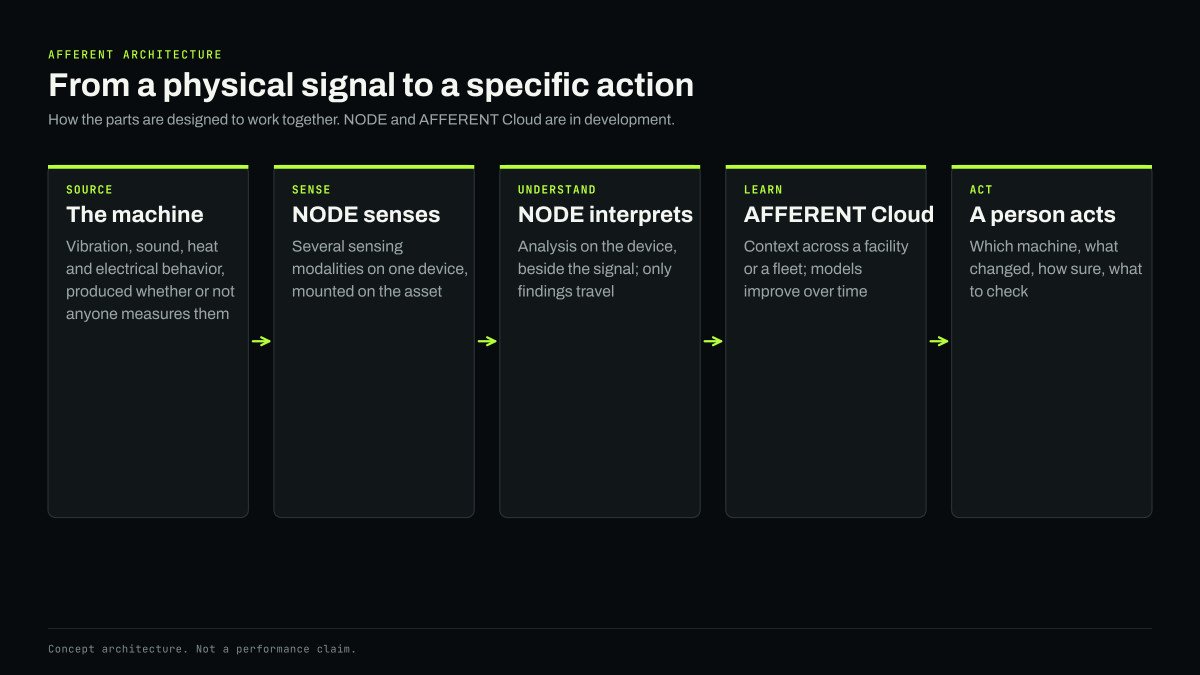
NODE is an intelligent device that mounts on machinery and infrastructure. It is designed to observe an asset through several kinds of sensing at once, including vibration, acoustics, temperature and electrical behavior, and to analyze what it observes on the device itself. NODE is planned as a family of three: Mini, Industrial and Critical, sized for different environments.
AFFERENT Cloud is software designed to bring together what devices report across a facility or a fleet, put each finding in context, and present machine health in a form that a maintenance planner or an operator can act on.
Machine Health Intelligence is our name for the models, and the understanding behind them, intended to recognize how equipment behaves before it fails. It is where signal processing, physics and machine learning meet.
Why the analysis starts on the device
The physical side effects of a machine at work are rich and heavy. A single vibration sensor sampling fast enough to see an early bearing defect can produce gigabytes of raw data a day. Most of that data describes a machine behaving exactly as it did yesterday. Sending all of it to a data center is costly, slow, and on many industrial networks simply not possible.
So the first layer of interpretation belongs beside the signal. NODE is designed to learn what normal looks like for the specific asset it is attached to, notice when that pattern changes, and send findings rather than streams. The cloud then does the work that needs a wider view: comparing similar machines, tracking slow trends and improving the models that run on the devices. The approach is described in more depth on our page about edge AI.
Why several kinds of sensing
Machines rarely fail in only one physical domain. A bearing defect usually shows up first as a change in vibration, may later be audible as a change in sound, and eventually produces heat. Loose electrical connections warm up and can change the current a motor draws. When a pump starts to cavitate, it produces a characteristic crackling sound and a broad rise in high-frequency vibration.
A single measurement can also mislead. Consider a temperature rise: it may mean a fault, or a hot afternoon, or a change in load. Vibration spikes sometimes come from a neighboring machine. Reading several signals from the same asset at the same moment helps separate a genuine change in the machine from ordinary variation in its surroundings, and it helps point to the likely cause. That is why NODE is designed around multimodal sensing rather than a single sensor type.
Why the name
In anatomy, afferent pathways carry signals from sensory receptors toward the central nervous system. They are how a body knows what is happening at its edges: pressure on a fingertip, heat on the skin, strain in a joint. The pathways that carry commands outward, to the muscles, are called efferent.
Industrial systems have a well developed efferent side. Controllers start and stop equipment, hold setpoints and respond to commands with great precision. The afferent side, the part that reports how the machinery itself is holding up, has been thin. Our devices are meant to be the receptors, networks carry the signals, and our software is where signals become awareness. The name describes the architecture.

Where the work applies
The environments we are designing for share one trait: the equipment matters more than it is watched. In data centers, power and cooling reach every rack through chains of pumps, chillers, fans, switchgear and uninterruptible power supplies, and a fault anywhere along the chain can stop the computing it serves. Manufacturing lines depend on motors, gearboxes, compressors and conveyors that are often maintained by calendar. Across energy and utilities, transformers and remote assets are spread across distances that make frequent inspection expensive. Hospitals, campuses and large commercial buildings rely on air handlers, chillers and pumps that nobody notices until they stop.
These settings differ in their equipment and their constraints, which is why NODE is planned in three sizes and why the software is designed to work with intermittent connectivity and existing maintenance systems.
The experience we are designing for
It helps to describe the goal from the point of view of the people we want to serve. Picture a reliability engineer responsible for a few hundred motors, pumps and fans across a plant. Today, much of that equipment is checked on a monthly or quarterly route, with a handheld instrument, if it is checked at all. Between visits, a machine can change a great deal without anyone knowing.
The experience we are designing for looks different. A device on a pump notices that a vibration pattern associated with bearing wear has started to grow, and that the pump's temperature is drifting upward under the same load. It sends a short, specific finding: which machine, what changed, how quickly, and the evidence behind it. The engineer reads it in the maintenance system they already use, checks the attached waveform, and schedules a bearing replacement for the next planned stop, weeks before the pump would have failed.
Nothing in that story requires a breakthrough in physics. Vibration analysis, thermal monitoring and acoustic inspection are mature disciplines. What has changed is the cost of putting capable sensing and computing on every machine, rather than visiting a few of them occasionally. The hard part is doing it reliably, at scale, with findings that people trust. That is the work we have chosen.
Who is building it
AFFERENT was founded by three friends, each of whom leads one layer of the system. Harrison Brooks, Co-Founder and Chief Technology Officer, leads the sensing layer: NODE hardware, sensors, embedded firmware and ruggedization. Spencer Williams, Co-Founder and Chief Scientist, leads the intelligence layer: edge AI, physics-informed machine learning, signal processing and failure models. Graham Johnson, Co-Founder and Chief Executive Officer, leads the infrastructure layer: AFFERENT Cloud, industrial security, enterprise integrations and the commercial side of the business. You can read more about them on the founders page.
How we intend to behave
We are a young company with a large ambition, and we mean to keep those two facts in proportion. On this site you will find product pages that state their development status, renders that are labeled as renders, and no customer names, deployment counts or performance figures that we cannot support. When we publish a number, we say where it came from.
The industries we want to serve run equipment that people depend on, and their engineers are rightly skeptical of monitoring products that promised a great deal and delivered alarms. In those industries credibility comes first. We would rather earn it slowly than claim it early, and we expect to be judged on evidence.
The long view
Physical infrastructure changes on a scale of decades, and the companies that serve it have to be built on the same scale. Our near-term work is specific: a device that captures clean signals in hard environments, models that can tell a real change from ordinary variation, and software that turns those findings into decisions. The longer arc is a world in which machines and infrastructure can report their own condition as a matter of course, the way a body reports pain before an injury becomes serious.
That is AFFERENT's mission. This news section is where we will explain the engineering behind it, share what we learn, and say so when something turns out to be harder than expected.


