

A facility is not one kind of place. The same site can hold a quiet plant room full of small circulation pumps, a production hall where motors and gearboxes run around the clock, and a fenced yard where a transformer and a backup generator sit outdoors in all weathers. Each of those environments asks something different of a monitoring device. Each also produces the same basic kind of evidence: vibration, sound, heat and electrical behavior that change as machines wear.
That combination of different environments and shared physics is the reasoning behind the NODE family. AFFERENT is developing three devices, NODE Mini, NODE Industrial and NODE Critical, designed to share one approach to intelligence while differing in the ways that the places they live require. This article explains how the family is meant to fit together, how an operator might choose between the models, and what we are and are not saying about them at this stage. All three are in development.
Why a family, not one device
The simplest product would be a single device for every asset. It would also be the wrong size almost everywhere. Built for a substation transformer, it would be too large and too costly to put on a fan coil unit. Built for a fan coil unit, it would be out of its depth on a transformer.
The economics of monitoring point the same way. Most facilities have a small number of assets whose failure would stop everything, a larger group of important working machines, and a long tail of small equipment that is individually cheap and collectively responsible for a great deal of disruption. The general guidelines for condition monitoring in ISO 17359 start from exactly this kind of assessment: understand which equipment matters most and how it fails, then choose the monitoring to suit.
A family lets each part of that pyramid get a device of the right size and depth, without splitting the facility into separate systems that do not talk to each other.

The three models
NODE Mini is designed for coverage. Its intended territory is the large population of smaller assets that have never justified a dedicated monitoring system: circulation pumps, fan motors, air handling units, small compressors and auxiliary drives in commercial buildings, data centers, laboratories and around the primary processes in manufacturing. The intent is a device small enough to mount in tight spaces, simple enough to install in minutes and economical enough to deploy in quantity. Its case rests on numbers. Where the count of assets, more than the value of any one of them, is the problem, Mini is the intended answer.
NODE Industrial is designed as the core of the family and the model most deployments are expected to be built around. Its intended territory is the working machinery of plants and facilities: electric motors and the equipment they drive, chilled-water, process and circulation pumps, compressors, fans and blowers, gearboxes and conveyors, and the cooling plant of data centers and large buildings. These machines reward close attention because their faults develop in well understood, physically distinct ways. NODE Industrial is designed to observe through several modalities at once and to do substantial analysis on the device, so that a finding says what is changing and where to look first.
NODE Critical is designed for the assets whose failure is least acceptable: power transformers and substation equipment, generators and backup power, primary plant in critical infrastructure such as major pumping equipment, and remote or unattended assets that are inspected rarely. Its design priorities are dependability, autonomy when connectivity is poor, resilience to weather, temperature extremes and strong electromagnetic fields, and security proportionate to the asset it sits on.
What stays the same
The three models are planned to differ in size, sensing depth, ruggedization and the kinds of assets they suit. They are designed to share everything that should not differ.
- Edge analysis. All three are intended to analyze signals on the device and send findings rather than streams of raw data, an approach we described in our look inside an industrial sensor node.
- One cloud. Every model is planned to report to the same AFFERENT Cloud, where findings sit in the context of an asset's history and of similar assets elsewhere.
- One security model. Device identity, encrypted communication, connections initiated by the device and verified updates are treated as common requirements, set out on our security page.
- Observe, do not control. NODE is a sensing device. It is designed to watch equipment, not operate it, which keeps it outside the control and protection systems that plants and networks rely on.
- Shared learning. Models are intended to improve from what the whole fleet observes, so a pattern learned on a pump in one place can help interpret a similar pump somewhere else.
For an operator, that means one system to learn, one place to see findings, one set of security reviews and one way of working, regardless of how many models are in use.
Choosing a model
Three questions usually settle which device suits an asset.
- How costly is an unplanned failure? The higher the consequence, the more depth of sensing and dependability the device needs.
- How harsh is the environment? Outdoor yards, substations and remote sites ask more of a device than a plant room does.
- How many assets of this kind need covering? When the answer is hundreds, ease of installation and cost per point matter most.
The matrix below summarizes where each model is intended to fit, based on the published product pages.
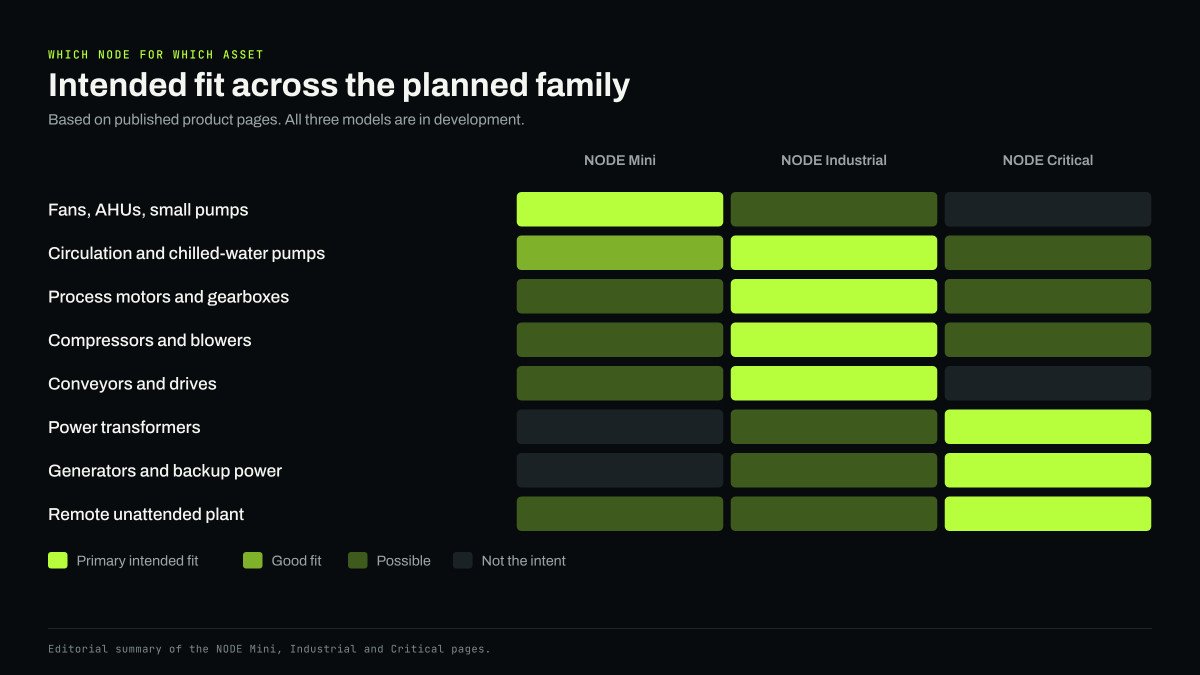
The overlaps are deliberate. A circulation pump serving one floor of an office building is a Mini asset. Put that pump on the supply to an operating theater, or to a row of liquid-cooled racks, and it may justify Industrial. An ordinary pump at an unattended station miles from the nearest crew may justify Critical, because the environment and the cost of a visit change the answer even when the machine does not.
A worked example
To make the logic concrete, consider an illustrative site: a mid-sized hospital campus with its own central plant. The counts below are assumptions for teaching, not a description of any real customer or deployment.
| Asset group | Approximate count | Consequence of failure | Intended model |
|---|---|---|---|
| Fan coil units, small circulation and condensate pumps | 400 | Local discomfort, small repairs | NODE Mini |
| Air handling unit fans and motors | 60 | Ward or theater conditions drift | NODE Mini or Industrial, by area served |
| Chilled and heating water pumps, chillers, cooling tower fans | 30 | Plant capacity lost for whole campus | NODE Industrial |
| Medical air and vacuum compressors | 6 | Clinical services affected | NODE Industrial |
| Main transformers and standby generators | 6 | Campus on emergency power or worse | NODE Critical |
Most of the devices on such a site would be Mini units, spread for breadth. Most of the depth would sit on a few dozen Industrial units in the central plant and compressor rooms. A handful of Critical units would watch the assets where the consequences are greatest. All of them would appear in one view, with findings ranked by consequence rather than by which device produced them.
The breadth pays off in a way that is easy to underestimate. The Mini product page makes the point that many modest observation points, read together, can describe the condition of a whole system in a way that a single well instrumented machine cannot. Twenty air handlers reporting slightly higher fan vibration in the same week says something about the building, the filters or the season, not only about twenty fans.
Starting small and growing
Having three models also changes how a deployment can begin. A site does not need to decide on day one how it will cover every asset. A common pattern in condition monitoring is to start where the consequences are clearest, prove that findings are useful and acted on, and then extend coverage. With one platform across three devices, that expansion does not mean adopting a second system. A campus could begin with Industrial units on its central plant, add Critical units to its transformers and generators, and later spread Mini units across its air handling and terminal equipment, with each step building on the same history, the same findings format and the same team habits.
Where to learn more
NODE is in development. The product pages describe the intended fit, design priorities and shared architecture of each model, and they are the best place to follow the family as it matures. The design thinking behind the renders, and the environmental facts that shape it, are the subject of our earlier piece on NODE's product philosophy.
One intelligence
The family exists because facilities are varied and physics is not. A bearing defect produces the same kind of evidence on a fan coil pump and on a transformer cooling fan. The device that sees it should suit the place it lives, and the intelligence that interprets it should be the same everywhere. That is the idea behind NODE Mini, Industrial and Critical: different bodies, one way of understanding machines.


