

Electricity networks are in the middle of the largest digitization effort in their history. Smart meters report consumption at short intervals. Distribution management systems model feeders in real time. Synchronized measurement units track the dynamics of the transmission system. Utilities run analytics on customer data, outage data and weather data that would have been unimaginable twenty years ago.
Almost all of that effort is aimed at two things: the electrical state of the network and the behavior of its customers. Much less of it is aimed at a third thing, the physical condition of the equipment that carries the power. That is a strange gap for an industry whose largest assets take years to replace. This piece argues that energy infrastructure needs an intelligence layer for equipment health, describes what such a layer would look like, and sets out the principles it should follow.
Money is about to follow the grid
The scale of what lies ahead makes the question urgent. In Electricity Grids and Secure Energy Transitions, the IEA found that global grid investment had stayed roughly flat at around 300 billion dollars a year for more than a decade, even as investment in renewables nearly doubled. To meet national climate targets, it estimated that grid investment would need to nearly double by 2030 to more than 600 billion dollars a year, with emphasis on digitalizing and modernizing distribution grids. The same report found that the need for flexibility in power systems doubles between 2022 and 2030 in a scenario consistent with national climate goals.
Investment on that scale raises a practical question for every utility: which assets should be replaced, which reinforced, and which can safely carry more for longer? Answering it well requires knowing the condition of the equipment already in the ground. In many networks, that knowledge exists for the largest assets and is sparse or stale for the rest.
A network seen through a few windows
Consider a synthetic regional network: one bulk substation feeding twelve distribution substations, which in turn serve about ninety substation and pole-top transformers. The numbers are invented, but the pattern will be familiar to anyone who has worked in a distribution utility.
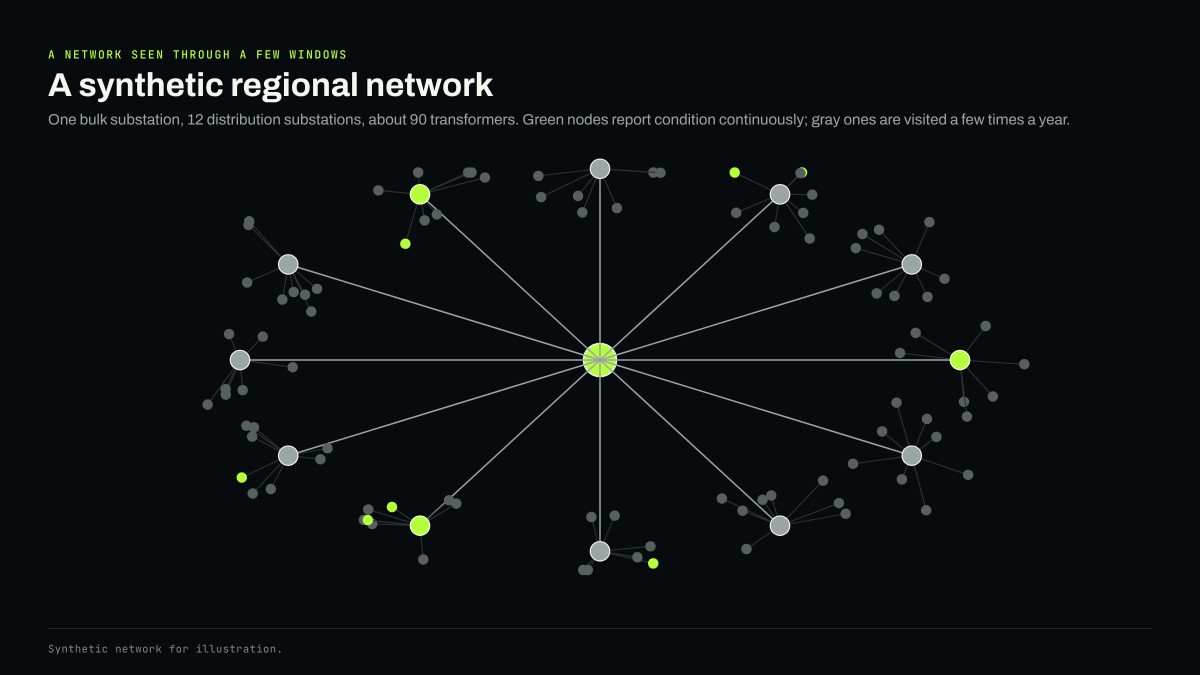
The bulk substation, with its large transformers, is well monitored, with online gas analysis and temperature monitoring on the main units. Three of the twelve distribution substations have some continuous condition data, because they were built or refurbished recently. Among the ninety or so transformers, a handful report anything beyond their electrical output, typically the ones that have already given trouble.
Counting all the nodes in the diagram, roughly one in twelve tells the utility anything about its own physical condition between visits. The rest are known through inspection rounds, annual oil samples where those are taken, and outage reports. The utility's electrical model of this network may be excellent. Its picture of the equipment's health is a few windows in a long wall.
We described why this matters for individual assets in the grid should be able to feel itself, and how transformer condition is assessed in our guide to transformer condition monitoring. The argument here is about the network as a whole.
What an intelligence layer is
An intelligence layer for energy assets is a shared, continuously updated understanding of the condition of equipment across a network. It sits between the physical assets and the people and systems that make decisions about them.
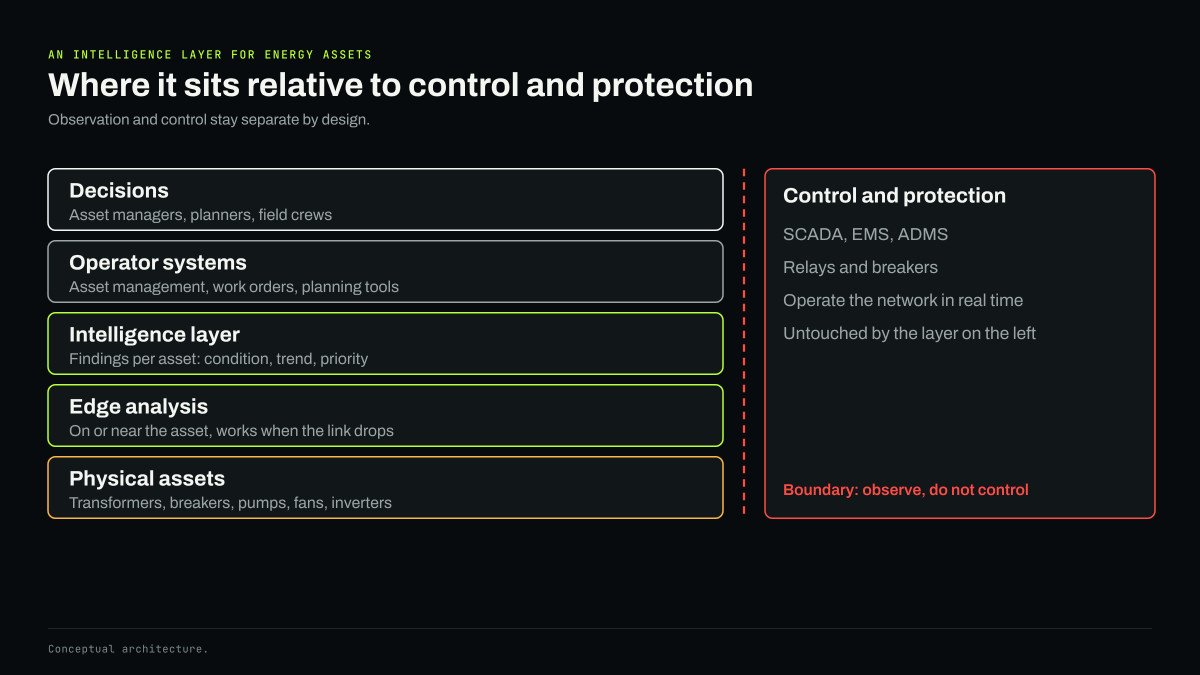
At the bottom are the assets themselves: transformers, breakers, cooling systems, pumps, fans, inverters and the balance of plant at generation and storage sites. Above them, sensing and edge analysis turn physical behavior into findings close to the asset, which matters at sites with limited communications. The intelligence layer combines those findings with history and with what is known about similar equipment, and produces something a planner or crew can use: this unit's condition, how it is trending, and how urgently it needs attention compared with everything else.
Above the layer sit the systems utilities already use for asset management, work orders and capital planning. It should feed them rather than replace them. A finding about a cooling fan on a substation transformer is only valuable when it becomes a work order with the right priority, assigned to the right crew, at a sensible time.
Why it is a layer, not a project
Utilities have bought monitoring for decades, usually one asset class or one vendor at a time: a gas monitoring system for the largest transformers, a separate system for breakers, another for generator plants, manual programs for everything else. Each solves a real problem. Together they leave the utility with islands of data in different formats, with different alarm conventions, that no one can easily compare.
Calling it a layer is a claim about architecture. A layer is common to many assets. It applies one way of expressing condition, one way of ranking findings and one security model across equipment types and sites. It lets a planner ask a network-wide question, such as which twenty transformers in the region are aging fastest relative to their load, and get an answer that does not depend on which vendor happened to supply which monitor.
That is close to what the physical infrastructure intelligence layer on our platform is designed to provide: signals interpreted at the edge, findings combined centrally, and patterns learned across many assets over time.
Principles worth insisting on
Observe, do not control. An equipment health layer should have no ability to operate anything. Grid safety depends on protection and control systems that are engineered, tested and governed to exacting standards. A layer that can only observe cannot interfere with them, and cannot become a route into them.
Security from the start. Energy infrastructure is a recognized target. NIST's Guide to Operational Technology Security and the ISA/IEC 62443 series set out how industrial systems should be segmented, authenticated and maintained. Devices in an intelligence layer should have their own identities, encrypt their communications, initiate their own connections rather than accept inbound ones, and accept only verified updates.
Work when the network does not. Substations and remote generation sites often have constrained or intermittent communications. Analysis on or near the asset keeps the layer useful when links drop, and reduces the volume of data that has to travel.
Breadth before perfection. The largest assets already have good monitoring. The value of a layer comes from extending awareness to the many smaller assets that have little. That favors equipment that is economical to install, needs little configuration and can be mounted without long outages.
Findings, not data. Utility engineers are already overloaded. Delivering raw signals adds work. Delivering ranked, explained findings, with the evidence available for anyone who wants it, saves work.
What it would change
An equipment intelligence layer would not change the physics of transformers or the economics of copper. It would change the quality of decisions made about them.
| Decision | Without condition intelligence | With it |
|---|---|---|
| Capital replacement | Mostly by age and failure history | By measured condition and aging rate, unit by unit |
| New load connections | By nameplate rating and models | Also by how hard nearby equipment is already working |
| Maintenance scheduling | Fixed rounds across all sites | Crews directed to sites with findings |
| Storm and heat preparation | General readiness | Known weak units identified in advance |
| Spare equipment strategy | Based on fleet averages | Based on which units are actually at risk |
Each row is a decision utilities already make. Condition intelligence does not add new decisions. It replaces assumptions with observations.
Objections worth taking seriously
"We already have monitoring on the assets that matter." Often true for the largest units. But failures on smaller transformers, cooling systems and distribution equipment cause many of the outages customers actually experience, and those are the assets with the least coverage.
"More data will bury our engineers." It will if the layer delivers data. The argument here is for findings: a short, ranked list of units that need attention and why, with everything else staying quiet.
"Regulators fund assets, not information." Cost recovery rules vary, and utilities rightly need to justify spending. The case for condition intelligence is strongest when it is tied to capital decisions it improves, such as deferring a replacement that measured condition shows is not yet needed, or bringing forward one that is.
"It is another system to integrate." That is a fair concern, and the reason a layer should feed existing asset management and work order systems rather than ask crews to watch a new screen.
The layer the digitization left out
The grid's digitization has been remarkable, and it is far from over. But a network that knows every customer's consumption by the quarter hour and its own transformers' condition once a year has digitized its edges and its electrical state while leaving its equipment largely unobserved.
The coming decade of grid investment will be spent better if it is spent on evidence. Building that evidence across thousands of distributed assets, continuously and securely, without touching the systems that keep the lights on, is the case for an intelligence layer in energy infrastructure.


