

When people picture a data center, they picture the server hall: long rows of racks, blinking lights, cold aisles and hot aisles. The equipment that keeps that hall alive is mostly elsewhere. It is on the roof, in the yard and in mechanical galleries full of pipes: cooling towers, chillers, pumps, heat exchangers, air handlers and, increasingly, the coolant distribution units that feed liquid-cooled racks.
Cooling is where data centers most resemble traditional industrial plants, and where the methods of industrial condition monitoring could matter most. This article explains how a typical cooling plant is put together, how its machines fail, and where predictive intelligence is likely to pay off first.
How the heat leaves
Every watt delivered to IT equipment becomes heat that must be removed. Uptime Institute's 2024 global survey put the industry's average power usage effectiveness at 1.56, which means that for every unit of energy used by IT, roughly another half unit goes to everything else, with cooling the largest share in most facilities.
Designs vary widely, but many larger facilities use a chilled-water plant built from two loops in series.

In the chilled-water loop, pumps circulate cold water to computer room air handlers (CRAH units) in air-cooled halls, or to coolant distribution units (CDUs) that serve liquid-cooled racks. The water picks up heat and returns to the chillers. In the condenser-water loop, a second set of pumps carries heat rejected by the chillers to cooling towers, where fans and evaporation release it to the outside air. Many plants also use economizers that bypass the chillers when outside conditions allow, and smaller facilities often use direct-expansion computer room air conditioners (CRAC units) instead of chilled water.
Liquid cooling adds a further loop close to the IT equipment. A CDU uses a heat exchanger to separate facility water from a technology coolant loop that runs through cold plates on processors. That loop has its own pumps, filters and sensors, and it sits very close to the most valuable hardware in the building.
A chain of machines
Seen from a reliability perspective, the cooling plant is a chain. Heat has to pass through every link in turn, and each link is a machine with moving parts. Redundancy is designed in at several points, so most single failures do not stop the room. But redundancy can also hide gradual decline, as we discussed in AI data centers have a physical reliability problem: a standby pump that has gradually degraded offers less protection than the design assumed.
Cooling problems also leave less time to respond than they once did. Uptime's 2024 survey notes that cooling failures can generally be tolerated because of thermal ride-through, but that ride-through times have become shorter as density increases, outside temperatures rise and data hall set points are raised. It adds that the reliability of liquid cooling is, as yet, untested at scale in the field. In Uptime's 2025 outage analysis, 13% of operators named cooling as the cause of their most recent impactful outage, behind power at 54%.
How cooling machines fail
The machines in a cooling plant are familiar to any industrial maintenance team, and so are their failure modes.
Pumps suffer bearing wear, seal leaks, misalignment with their motors, impeller wear and cavitation when suction conditions are poor. Most of these faults develop over weeks or months and show up in vibration, sound and temperature well before the pump stops.
Chillers combine compressors, heat exchangers and controls. Compressor bearing and motor faults, refrigerant leaks and fouled condenser or evaporator tubes all degrade performance gradually. A fouled heat exchanger does not usually trip a chiller; it makes the chiller work harder for the same cooling, until there is no margin left on a hot day.
Cooling tower fans and gearboxes run outdoors, often at the top of the plant where they are hard to inspect. Gear wear, bearing damage, imbalance from fouled or damaged blades and loose structures are common. They tend to fail at the worst time, during peak heat when every cell is needed.
CRAH fans and CDU pumps sit closest to the IT load. Fan bearing wear and imbalance, and in CDUs, pump wear, filter clogging and flow changes, directly affect how much heat can be removed from the racks they serve.
Variable frequency drives and motor starters control most of these machines. Their faults are electrical: overheating components, failing cooling fans inside the drive cabinet and degraded connections.
Matching signals to faults
Each kind of fault leaves evidence in particular signals. A practical monitoring design starts from the assets and their common failure modes and chooses the measurements that reveal them, rather than starting from whatever data the building management system already collects.
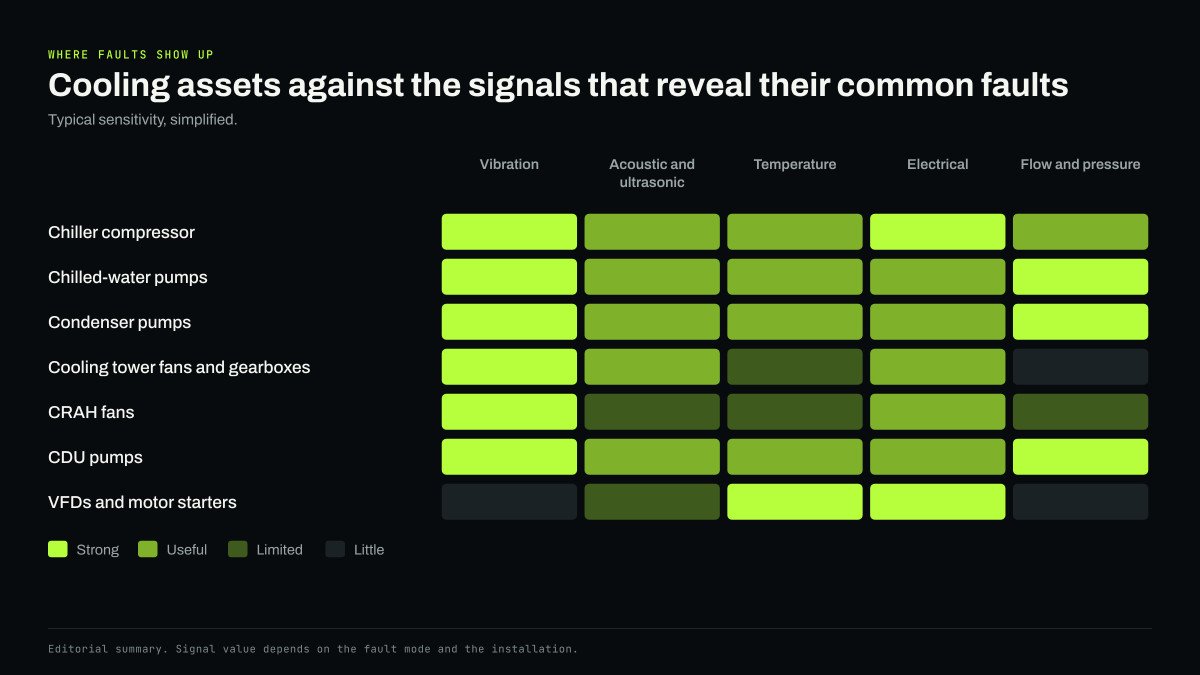
Vibration is the strongest single signal for rotating equipment: pumps, fans, compressors and gearboxes. Acoustic and ultrasonic sensing adds early warning of friction, cavitation and leaks. Temperature is valuable for bearings in combination with other signals and for electrical components on its own. Electrical measurements reveal motor and drive problems. Flow and pressure across pumps, filters and heat exchangers show how the loops as a whole are performing.
Most building management systems collect some of this already, particularly temperatures, pressures, flows and drive status. What they rarely capture is the condition of the rotating machines themselves, and that is where faults usually begin.
Where predictive intelligence could matter most
Three characteristics make data center cooling a strong candidate for predictive approaches.
Faults give warning. The dominant failure modes of pumps, fans and gearboxes are gradual and physically detectable. That is the precondition for predictive maintenance, as we set out in our comparison of predictive and preventive maintenance.
Consequences are high and rising. As rack densities climb and ride-through times shrink, the cost of losing cooling capacity grows. A degraded pump discovered during a planned window is a routine job. The same pump failing during a heat wave, with its standby also degraded, is an incident.
Windows are scarce. Facilities running continuous workloads have limited opportunities for intrusive maintenance. Knowing which machines actually need attention lets teams use those windows well, rather than spending them on calendar tasks for healthy equipment.
The likely first targets are the machines that combine high consequence with good warning: chilled-water and condenser pumps, cooling tower gearboxes and fans, CDU pumps and the drives that run them.
Monitoring does not have to start everywhere at once. A sensible first step is to rank cooling assets by the consequence of their failure and the lead time their faults usually give, instrument the top of that list, and expand as findings prove useful. A plant that learns which of its pumps and fans run hard, and which barely work at all, also gains information for capacity planning, not only for maintenance.
A monitoring plan for one chilled water plant
To make this concrete, here is how an operator might lay out condition monitoring for a typical chilled water plant serving a data hall: two chillers, two cooling towers, and redundant chilled water and condenser water pumps.
| Asset | Signals | What they catch |
|---|---|---|
| Chiller compressors | Vibration, motor current, oil and discharge temperatures | Bearing wear, rotor issues, lubrication problems |
| Chiller heat exchangers | Approach temperatures, water side pressure drop | Fouling and scaling, low refrigerant charge |
| Chilled and condenser water pumps | Bearing vibration, motor current, seal area temperature | Bearing defects, misalignment, cavitation, seal wear |
| Cooling tower fans and gearboxes | Vibration, oil temperature | Gear wear, imbalance, loose blades |
| Motors and drives | Current balance, winding and drive temperatures | Insulation stress, overload, cooling faults |
Two design choices matter more than the exact sensor list. First, every unit in a redundant group needs its own monitoring, because the group's output will look normal while one unit wears. Second, the standby units deserve attention too. A pump that sits idle for weeks can develop problems of its own, and the moment it is needed is the worst time to discover them. Rotating duty between units on a schedule, and confirming each unit's condition as it takes over, closes that gap.
What good looks like
A mature approach to cooling plant reliability would look much like the best practice in process industries. Critical rotating machines would be monitored continuously, with analysis that learns each machine's normal behavior at its own speeds and loads. Findings would be specific: which pump, which bearing, what changed and how confident the system is. Standby equipment would be monitored as carefully as running equipment, so redundancy is real rather than assumed. And findings would flow into the work order systems that facilities teams already use.
None of this requires new physics. It requires applying well understood methods consistently to equipment that has often been treated as background. That is the opportunity in data center cooling intelligence, and it is the practical side of the argument we made in the AI factory is still a factory.


