

Most electronics are designed for a desk, a pocket or a server room: clean, dry, temperature controlled and close to a person who can fix them. The places where NODE is meant to live are none of those things. Pump rooms are humid and loud. Motor housings are hot and never stop shaking. Substation yards see frost, sun and rain. A data center mechanical gallery is clean but packed with equipment and electrical noise.
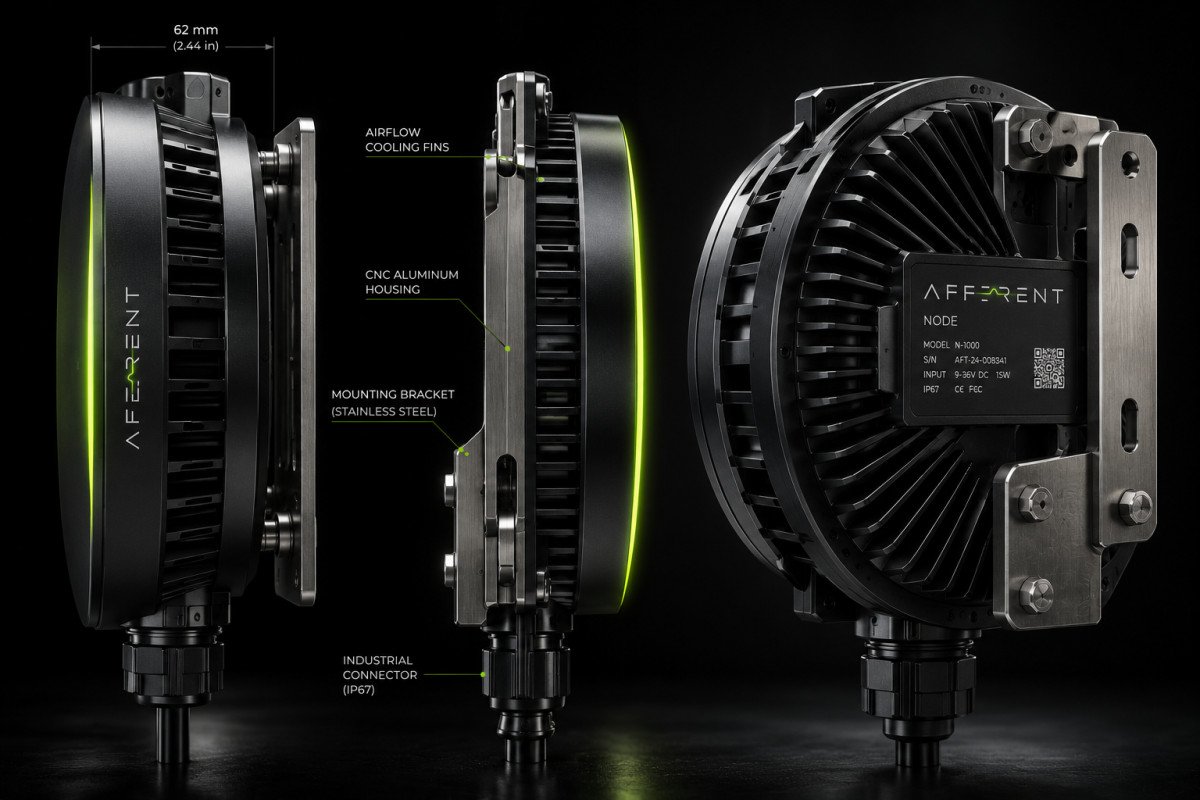
This article describes the product philosophy behind NODE: the environmental facts we start from, the design intent that follows from them, and the choices that shape how the family looks and works. NODE is in development. The images here are concept renders that show the design direction.
Start from the place, not the bench
It is tempting to design a sensor around its electronics and then put a box around them. We are trying to work the other way, starting from the places the device will live and the people who will install and maintain it. The NODE product pages state the starting point plainly: industrial surfaces are hot, the air carries dust, oil and moisture, everything vibrates, and electrical noise from drives and switchgear is constant. A device that is to live on a machine for years has to be designed for all of it.

Each of those facts leads to a design response. Heat calls for thermal design that keeps sensors and electronics within their limits while mounted on a warm machine. Dust and moisture call for a sealed enclosure and sealed cable entries. Vibration calls for mounting that couples the sensors firmly to the machine rather than to a flexible bracket. Electrical noise calls for shielding and signal integrity designed in from the beginning, not added after the first field trial.
The face of the device
NODE's front is deliberately calm: a round face, a wordmark and a single status light. Round enclosures have practical advantages in this setting: a circular seal can be clamped evenly, and there are no corners to collect grime. A round form also reads clearly as a single object when it sits among pipes, conduit and brackets.

The status light matters more than it might seem. People walk past monitored equipment every day, and most of them will never open a dashboard. A light that can be read at a glance from across a room, showing that a device is healthy, needs attention or has lost its connection, turns every passing technician into part of the system. We want the state of the device to be legible without a laptop.
Built to be mounted by busy people
The person installing a NODE is likely to be a maintenance technician with a list of other jobs. Every extra step, special tool or ambiguous instruction is a chance for a poor installation, and a poorly mounted sensor produces poor data. The design intent is that mounting, powering and commissioning a device should take few steps, and that the correct way to mount it should be the obvious way.
Mounting hardware is designed to hold the device rigidly against the machine surface, because a sensor that rattles on its bracket measures the bracket. Connector placement matters for the same reason, because cables need to run away from moving parts and hot surfaces. So does a compact profile, since the spaces around real equipment are crowded.
Mounting decides what a vibration sensor can hear. Accelerometer makers describe the trade clearly in guidance such as PCB Piezotronics on mounting accelerometers: a stud screwed into a prepared, flat surface gives the widest usable frequency range, a thin layer of adhesive comes close, and a magnet is quick but softens the high frequencies where early bearing evidence lives. A handheld probe is the least stiff of all. The practical consequence for design is that a permanent device should make a rigid mount easy, because the shortcut a busy technician takes on a Friday afternoon will define the data for years.
| Mounting method | Strength | Trade off |
|---|---|---|
| Stud on a spot faced surface | Stiffest coupling, widest frequency range | Needs drilling and tapping |
| Adhesive or epoxy pad | Close to stud performance, no drilling | Surface preparation and cure time |
| Magnet | Fast, movable | Loses high frequency response; can shift |
| Handheld probe | No installation at all | Low frequencies only; varies with the user |
Heat goes somewhere
A device that analyzes signals on board generates heat of its own, and it sits on equipment that is often warm already. The finned rear of the NODE concept reflects that. Thermal management is not an afterthought in a device of this kind: it decides how much analysis can run continuously, how long components will last, and whether temperature measurements reflect the machine or the device itself. Separating the heat the device makes from the heat it is meant to measure is one of the quieter design problems in multimodal sensing.
A simple example shows why. Suppose a bearing housing slowly warms from 55 to 58 degrees Celsius over a week, a change worth noticing. If the device on that housing warms itself by a similar few degrees whenever it runs heavier analysis, the two effects blur together, and the trend means nothing. The answer is partly physical, keeping the temperature sensing path well coupled to the machine and isolated from the electronics, and partly analytical, recording the device's own internal temperature so that self-heating can be recognized and removed.
One family, three jobs
NODE is planned as a family of three: Mini, Industrial and Critical. The models are intended to differ in size, sensing depth, ruggedization and the kinds of assets they suit, and to share the things that should not differ: how they analyze signals at the edge, how they communicate, how they are secured and managed, and the models they contribute to and learn from.

NODE Mini is designed for coverage, bringing continuous observation to the many smaller assets that have never justified a dedicated monitoring system. the middle model, NODE Industrial, is intended as the general-purpose device for motors, pumps, compressors, fans and the rotating equipment that production and cooling depend on. At the top of the range, NODE Critical is designed for the assets whose failure is least acceptable, such as transformers, generators and essential plant.
A shared design language across the family is practical as well as aesthetic. An operator should be able to recognize any NODE at a glance, read its status the same way, and manage all of them in one system. A facility could place compact devices across its many small assets and more capable devices on the few whose failure would stop everything, and see them all in one place.
Materials and finish
Industrial equipment is cleaned with pressure washers, splashed with oil and coolant, and handled by people wearing gloves. Surfaces and finishes have to tolerate all of that without degrading or becoming hard to read. A dark finish, like the one in our renders, hides grime and keeps a status light easy to see. Edges should be soft enough to handle safely and not snag clothing or cables. These are small decisions, but in a plant they decide whether a device still looks and works like new after a year on a machine.
What the renders are for
Concept renders are useful long before the first production unit exists. They help engineers, designers and future users talk about the same object. A maintenance team can look at a render and judge whether the device would sit flat on their motor housing, whether the connector would face a sensible direction, and whether the status light would be visible from the walkway.
That conversation is part of the product philosophy, not separate from it. The people who will use NODE know their machines better than anyone, and their feedback on a render costs far less to act on than a change after tooling.
Designed with the people who maintain machines
The best test of an industrial product is whether the people who live with it want to keep it. That depends on details: whether it survives the first winter on an exposed pump, whether a technician can mount it in ten minutes with ordinary tools, whether its light means something, and whether its findings are worth acting on. Those details can only be settled by putting devices in real environments and listening to the people who work there.
The architecture inside the device, described in our look at NODE's architecture, sets what it can sense and understand. The design outside decides whether it is installed well, trusted and kept. Both are part of the NODE product family, and both reflect the question the company began with, as our founders describe in their conversation about AFFERENT's origins.


