
A familiar piece of startup advice says to avoid hardware. Hardware needs capital before it earns revenue. It ties money up in inventory, iterates slowly, fails expensively in the field and usually carries lower margins than software. For two decades, the safest path to a large technology company has been to write code, sell subscriptions and let someone else worry about atoms.
That advice is sound for many markets. For infrastructure, we think it is often wrong. Some of the most durable businesses that serve physical systems began with something bolted to a building, a vehicle or a machine. Building it was hard. It was also the reason the business lasted.
An installed base that pays for decades
Elevators are a useful example because the economics are public. In its full-year 2025 results, Otis reported net sales of about $14.4 billion. New equipment, the business of making and installing elevators and escalators, contributed $4.99 billion. Service, which covers maintenance, repair and modernization of equipment already installed, contributed $9.44 billion.
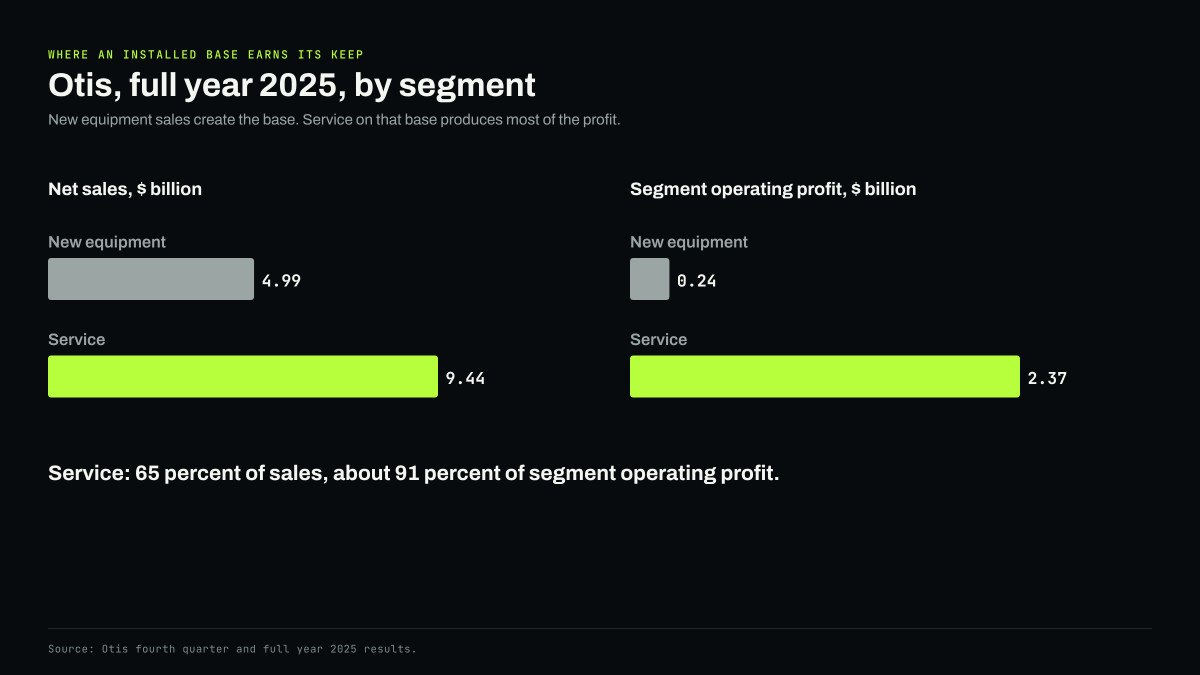
The profit split is more striking. Service produced about $2.37 billion of segment operating profit, against $240 million from new equipment. That is roughly 65% of sales and about 91% of segment operating profit. The company says it maintains approximately 2.5 million customer units worldwide. Each elevator installed becomes a relationship that can last as long as the building does.
The lesson is not that every hardware company becomes Otis. It is that in infrastructure, the first sale often matters less for what it earns than for what it makes possible.
The same pattern in connected operations
The pattern now shows up in businesses built around sensing and software. Samsara instruments vehicles, trailers and equipment with connected devices and sells software on top of them. In its fiscal 2026 results, published in March 2026, the company reported $1.9 billion in annual recurring revenue, up 30% year over year, and said that many customers extend beyond their initial deployment in vehicles into trailers, assets and maintenance. It describes the data generated by instrumenting physical assets as a proprietary data set that is increasingly difficult to replicate.
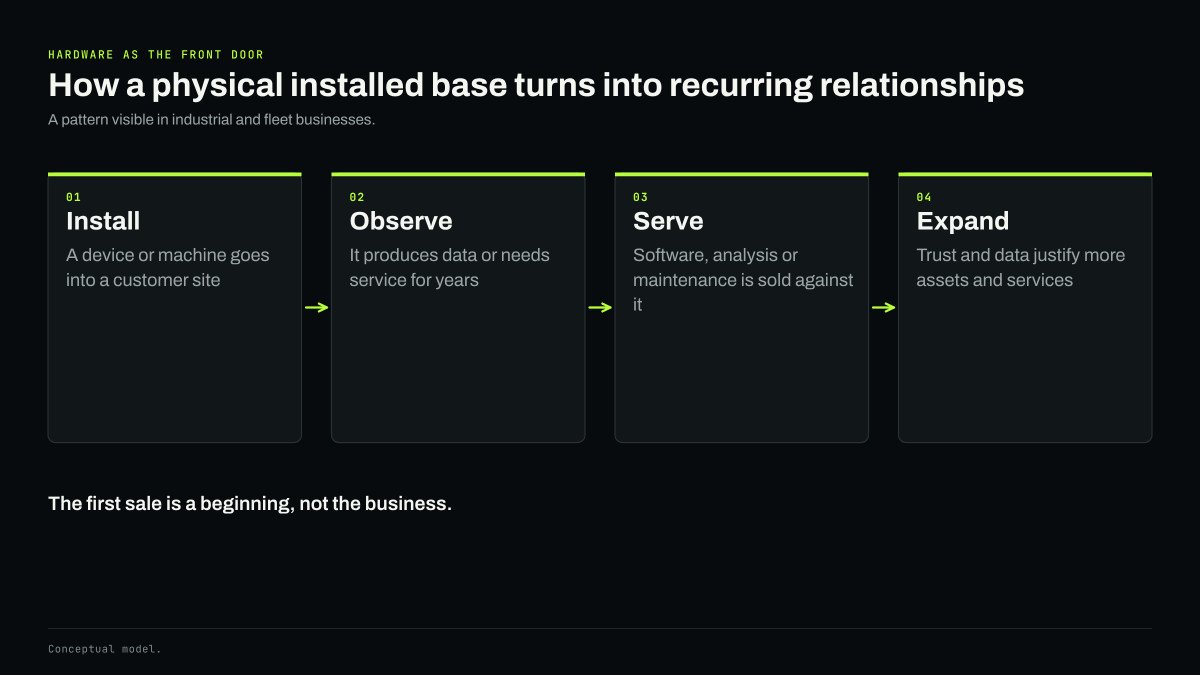
The details differ from elevators, but the structure rhymes. A device goes onto an asset. It produces data, or needs service, for years. Software, analysis or maintenance is sold against it. Trust built on the first assets leads to more assets.
What changes when the installed device can think
Traditional installed-base businesses run on people. Otis describes itself as 72,000 people strong, including 45,000 field professionals. Its service business works because technicians visit equipment regularly, find problems and fix them. It is a strong model, and a labor-intensive one.
Intelligent devices change the shape of the installed base in three ways. First, the device itself produces information continuously, so service can be directed to the assets that need it rather than spread across every asset on a schedule. Second, software updates can improve devices already in the field, so an installation made in the first year can be more useful in the fifth. Third, data from many installations can make each one smarter, which is something a purely mechanical installed base cannot do.
That does not remove the need for field work. It changes its value. A technician who arrives knowing which machine is degrading, and why, does more useful work per visit than one following a fixed route. The hardware creates the presence, the software turns presence into insight, and the service relationship becomes more valuable to both sides.
Why presence is the advantage
Some knowledge requires being there. The condition of a bearing, a winding or a cooling fan cannot be inferred from a database somewhere else. It has to be measured at the machine. A company without a device on the asset depends on someone else's measurements, with someone else's quality and someone else's priorities.
Installed devices are sticky. Once a device is mounted, configured, integrated with maintenance systems and trusted by the people who act on it, there is little reason to remove it. Replacing it means new installation work, new integration, lost history and a period of retraining. This is a switching cost earned honestly, through usefulness.
Control of the measurement shapes the data. As we argued in the next data moat is physical, the quality and consistency of machine data depend heavily on the instrument that collects it. A company that designs its own devices can keep that data comparable across thousands of sites and many years.
Distribution follows the field. Hardware brings people into plants, substations and machine rooms. Those visits build relationships with the maintenance and operations teams who decide whether a system is useful. Software sold from a distance rarely earns that kind of trust.
Rough unit economics
The economics of a hardware-plus-software business are easiest to see over the life of one installed device. The figures below are purely illustrative and are not AFFERENT prices or costs.
| Item | Year 1 | Years 2 to 5, each |
|---|---|---|
| Device gross profit (sold at $600, cost $400) | $200 | $0 |
| Software gross profit ($25 a month at 75% margin) | $225 | $225 |
| Installation and onboarding support | ($150) | $0 |
| Contribution | $275 | $225 |
Over five years, that device contributes about $1,175. The device margin is $200 of it, roughly 17%. The rest comes from the recurring relationship. If the device is removed after one year, the business barely covers its cost. If it stays for ten years, the contribution more than doubles. The value of the hardware is almost entirely in how long it stays useful on the asset, which makes reliability, installation quality and the usefulness of the software the real drivers of the business.
Why it is hard, and why that matters
None of this makes hardware easy. The difficulties are real.
- Capital comes first. Design, tooling, testing and inventory all need money before revenue arrives.
- Iteration is slow. A software bug can be fixed in a day. A hardware flaw in thousands of installed units can take a year and a recall to resolve.
- Field conditions are unforgiving. Heat, moisture, vibration and electrical noise find weaknesses that laboratory tests miss.
- Supply chains are fragile. Component shortages can stall production for months.
- Installation is labor. Every device has to be mounted by a person, on a real machine, correctly.
Those difficulties are also why a hardware position, once established, is hard to dislodge. A later competitor faces the same capital, the same slow scale-up and the same asset-by-asset deployment. The barrier that makes the business hard to start is the barrier that protects it once it works.
What separates the winners
Hardware alone is not a strategy. Many companies have shipped good devices and still failed, because the device was the whole product. The infrastructure companies that last tend to share a few traits.
- They treat hardware as the front door. The device exists to earn a lasting relationship, not to be the main source of profit.
- They design for long service lives. A device expected to stay ten years is designed, tested and supported differently from one expected to stay two.
- They sell outcomes. Operators buy fewer failures and better decisions, not sensors.
- They keep a consistent product family. A small number of well-designed devices that share software is easier to support and produces more comparable data than a sprawling catalog. We described that approach in one product family, one intelligence.
Questions worth asking of any infrastructure hardware company
The argument above is a pattern, not a guarantee. Anyone evaluating a hardware-led infrastructure business, as a customer, partner or investor, can test it with a few questions.
- How long is each device expected to stay in service, and what evidence supports that?
- What share of the value to the customer comes from software and analysis rather than the device?
- Do installed devices get better over time through updates, or are they fixed at the day they ship?
- How much effort does installation take, and who does it?
- Who owns the data, and what can the company do with it?
- What happens to the customer's data and history if the company changes its hardware?
Good answers to those questions are what turn an installed device into an installed relationship.
Our case, plainly
We are building a hardware company because we think the problem requires one. The condition of the world's machines has to be measured at the machines, and the business that does that well, for many years, may end up with the most valuable view of how physical infrastructure behaves. The reasoning is set out in more detail in AFFERENT's investment thesis, including the risks. It will be judged by execution, not argument. But the history of infrastructure suggests that the companies willing to do the hard physical work first are often the ones still standing decades later.


