

Every connected device mounted on an industrial machine is a small computer sitting inside someone else's operation. It has a processor, memory, a network connection and, often, a path to systems that matter. That is what makes machine intelligence useful, and it is also what makes it a security responsibility. An insecure monitoring device can become a way into a plant network, a source of false data that leads to bad decisions, or a fleet of thousands of identical weaknesses waiting for one exploit.
Operational technology security has a mature body of guidance. NIST's SP 800-82 Revision 3, the Guide to Operational Technology Security, and the ISA/IEC 62443 series set out how industrial systems should be segmented, managed and defended. This article focuses on what that guidance implies for the newest class of devices on the plant floor: connected sensors that analyze machine data at the edge and talk to cloud services.
Why edge devices are a distinct problem
Traditional industrial control equipment lives inside carefully managed networks and changes slowly. Connected monitoring devices break several of those assumptions at once.
- They are numerous. A site may have a handful of controllers and hundreds of sensors. Each one is an endpoint to secure, track and update.
- They are physically exposed. Devices mounted on motors in a pump house or on a transformer in a substation yard can be touched, unplugged or opened by anyone who reaches them.
- They talk outward. Their value often depends on sending findings to a cloud service, which means crossing boundaries that OT networks were designed to keep closed.
- They live a long time. A device installed on a machine may stay there for many years, through several generations of threats and software.
Those properties shape every security decision that follows.
A threat model, entry point by entry point
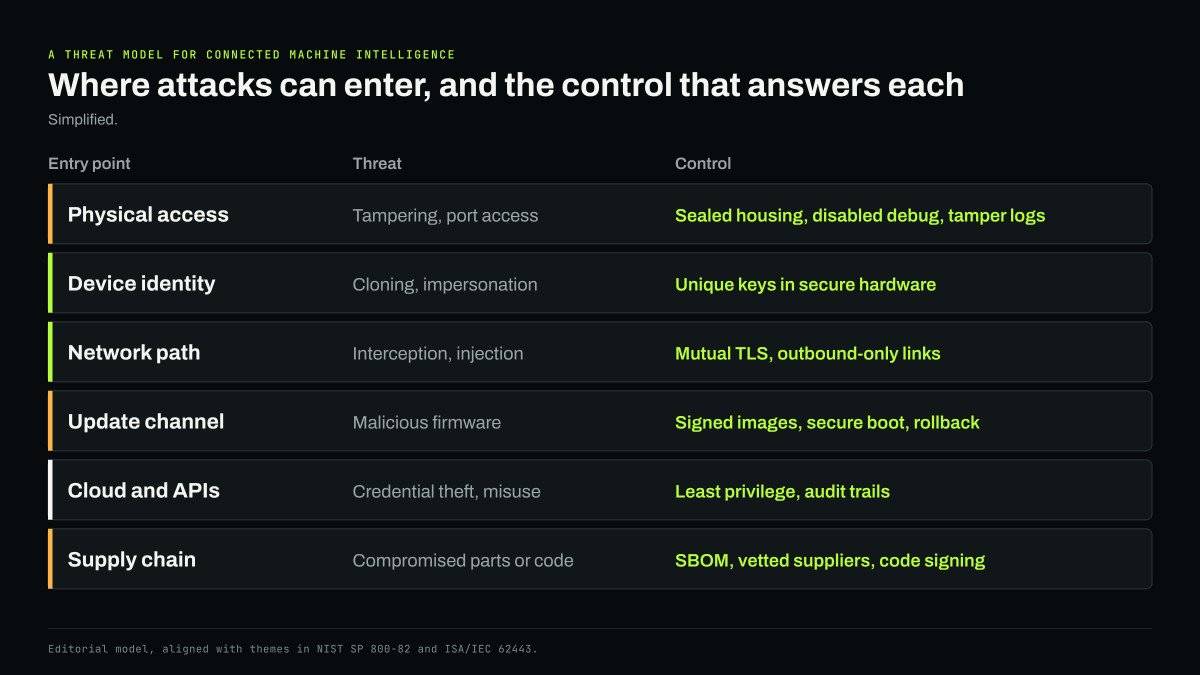
A threat model starts with a simple question: where could an attacker get in, and what would they want? For a connected industrial sensor, six entry points cover most of the ground.
Physical access
Someone with access to the device can try to open it, connect to debug ports or replace it with a lookalike. Sensible defenses include disabling or locking debug interfaces in production units, storing secrets in hardware designed to resist extraction, and logging tamper events so that the fleet notices when a device has been opened or moved.
Device identity
If one device's credentials can be copied to another, an attacker can impersonate it, feed false data or pull data that does not belong to them. The answer is a unique cryptographic identity for each device, generated or injected during manufacturing and protected by secure hardware. Shared passwords and fleet-wide keys are the classic failure here.
The network path
Data in transit can be read or altered. Mutual authentication with modern transport encryption, where the device verifies the server and the server verifies the device, closes most of this risk. Network design matters too: devices that only make outbound connections to known endpoints, and accept no inbound connections, present far less attack surface than devices that listen for commands.
The update channel
Updates are both the most important defense and the most dangerous attack path. A device that cannot be updated cannot be fixed. A device that accepts unsigned updates can be taken over. The established pattern is signed firmware images verified by a secure boot chain, the ability to roll back a failed update, and staged rollouts that start with a small group of devices before reaching the whole fleet.
Cloud services and APIs
The services that receive data and manage devices hold the keys to the whole fleet. Strong authentication, least privilege for every user and integration, separation between customers and complete audit trails are the basics. Compromise here is far more serious than compromise of a single device.
The supply chain
Components, libraries and build systems can carry weaknesses or malicious code into a product before it ever ships. A software bill of materials, vetted suppliers, reproducible builds and signed code reduce that risk and make it possible to answer quickly when a new vulnerability is announced in a common library.
A baseline worth meeting
NIST's NISTIR 8259A defines a core baseline of cybersecurity capabilities for connected devices. It is a useful checklist because it is short and concrete.
| NISTIR 8259A capability | What it means on an industrial sensor |
|---|---|
| Device identification | A unique logical and physical identity for every unit |
| Device configuration | Configuration changes only by authorized entities |
| Data protection | Stored and transmitted data protected from unauthorized access and change |
| Logical access to interfaces | Local and network interfaces restricted to authorized users and services |
| Software update | Software updatable by authorized entities through a secure mechanism |
| Cybersecurity state awareness | The device can report its own security state, such as tamper or failed checks |
For deeper requirements, IEC 62443 provides component level requirements in part 4-2 and secure product development lifecycle requirements in part 4-1. Meeting a baseline is a starting point, not an end state.
Security across the lifecycle

Most security failures in connected devices are lifecycle failures. The device was reasonably secure on the day it shipped, then the world changed around it. A complete approach covers six stages.
- Design. Threat model the product early, choose secure defaults and remove features that are not needed. NIST's Secure Software Development Framework describes the practices that keep vulnerabilities out of code in the first place.
- Provision. Give each device its identity in a controlled manufacturing step, and record what was installed on it.
- Commission. Join the device to the right network with the minimum permissions it needs, and confirm it is talking to the right services.
- Operate. Monitor the fleet for unusual behavior, failed authentication and tamper events, and keep logs long enough to investigate.
- Update. Patch promptly, using signed images and staged rollouts, for as long as the device is in service.
- Retire. Revoke credentials and wipe data when a device is removed, so that a discarded unit cannot be used to reach the fleet.
CISA's Secure by Design principles put the responsibility for this work on manufacturers rather than customers, and regulation is moving the same way. The European Union's Cyber Resilience Act entered into force in December 2024. Its vulnerability reporting obligations for manufacturers began to apply in September 2026, and most of its other requirements, including security updates across a defined support period, apply from December 2027.
The practical constraints
Security guidance is easy to agree with in a meeting and harder to apply on a pump skid. Several constraints are specific to industrial edge devices, and designs that ignore them tend to fail quietly in the field.
Certificates expire. A device certificate issued for five years on a machine that runs for fifteen needs a way to renew itself securely, without a technician visiting every unit. Renewal depends on time, and time depends on the clock: a device whose clock has drifted or reset may reject a perfectly valid server certificate, or accept an expired one. Reliable time synchronization is therefore a security function as much as a data quality one.
Connectivity is intermittent. A device behind a cellular link in a remote pump station may be offline for days. Updates have to resume cleanly after interruption, and the device must keep enforcing its security policy while it cannot reach the cloud.
Processors are small. Cryptography costs power and time on a constrained device, which pushes designs toward hardware acceleration and efficient algorithms rather than skipping protections.
People are busy. If commissioning a device securely takes twenty steps, someone will find a shortcut. The secure path has to be the easy path, ideally a single scan or tap that binds the device to the right site and account.
Segmentation and the plant network
A connected sensor should never become a bridge between networks that the plant has deliberately separated. SP 800-82 and IEC 62443 both describe dividing industrial environments into zones with controlled conduits between them. In practice, that suggests a few patterns for monitoring devices: place them in their own zone or on a dedicated network, send their traffic outbound through a controlled gateway or a cellular link that bypasses the control network entirely, and avoid any design in which the monitoring system can write to control systems unless that function is explicitly required and separately secured.
The last point matters as machine intelligence matures. Reading condition data carries a very different risk from changing setpoints or stopping equipment. Systems that move from advising people to acting directly on machines should treat that step as a new security boundary, with its own review.
Questions to ask any vendor
- Does each device have a unique identity protected in hardware?
- Is all communication mutually authenticated and encrypted, and does the device accept inbound connections?
- Are firmware updates signed and verified by secure boot, and how long will updates be provided?
- Can you produce a software bill of materials, and how do you handle newly disclosed vulnerabilities?
- How does the device fit our zones and conduits, and can it ever write to our control systems?
- What happens to credentials and data when a device is retired?
Edge intelligence moves computation onto the machine, as we explained in how edge intelligence works, and the choice of where each task runs is the subject of our piece on cloud, edge and device. Security has to follow that computation wherever it goes. We describe our approach to industrial edge security on our technology pages.
Sources
- NIST SP 800-82 Rev. 3, Guide to Operational Technology Security (2023)
- ISA/IEC 62443 series of standards
- NISTIR 8259A, IoT Device Cybersecurity Capability Core Baseline (2020)
- NIST SP 800-218, Secure Software Development Framework (2022)
- CISA: Secure by Design
- Regulation (EU) 2024/2847, the Cyber Resilience Act


